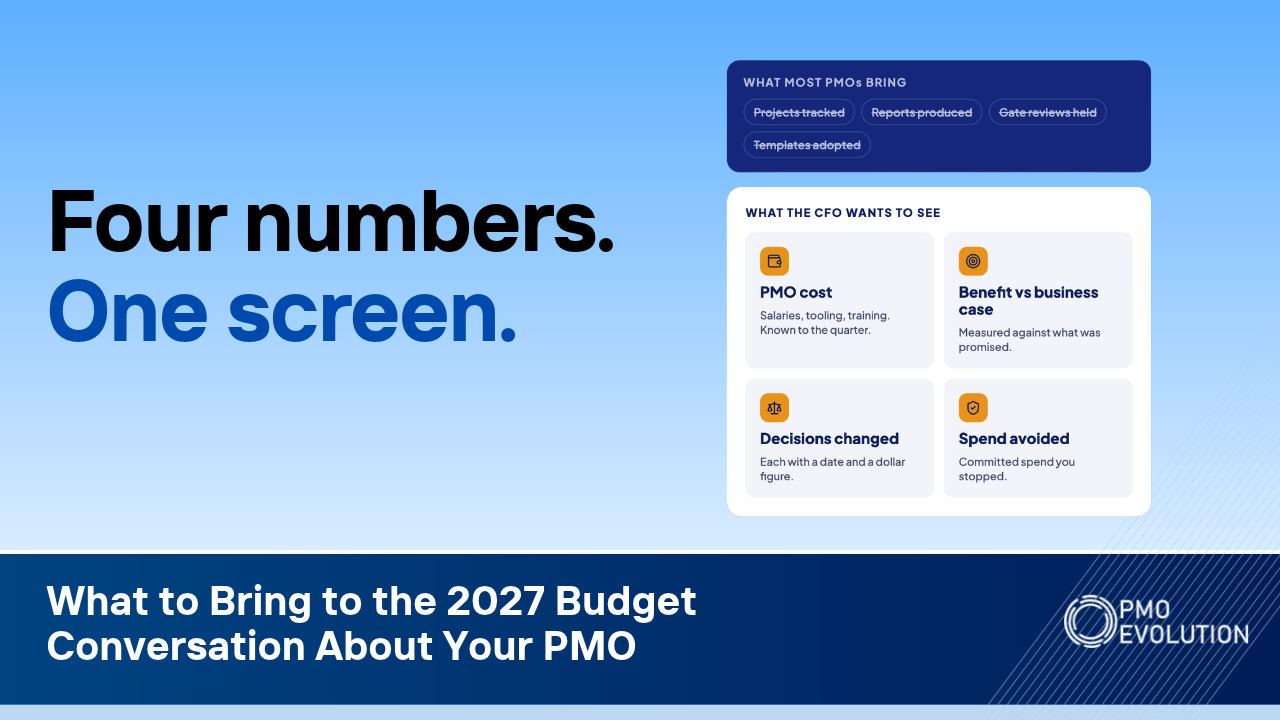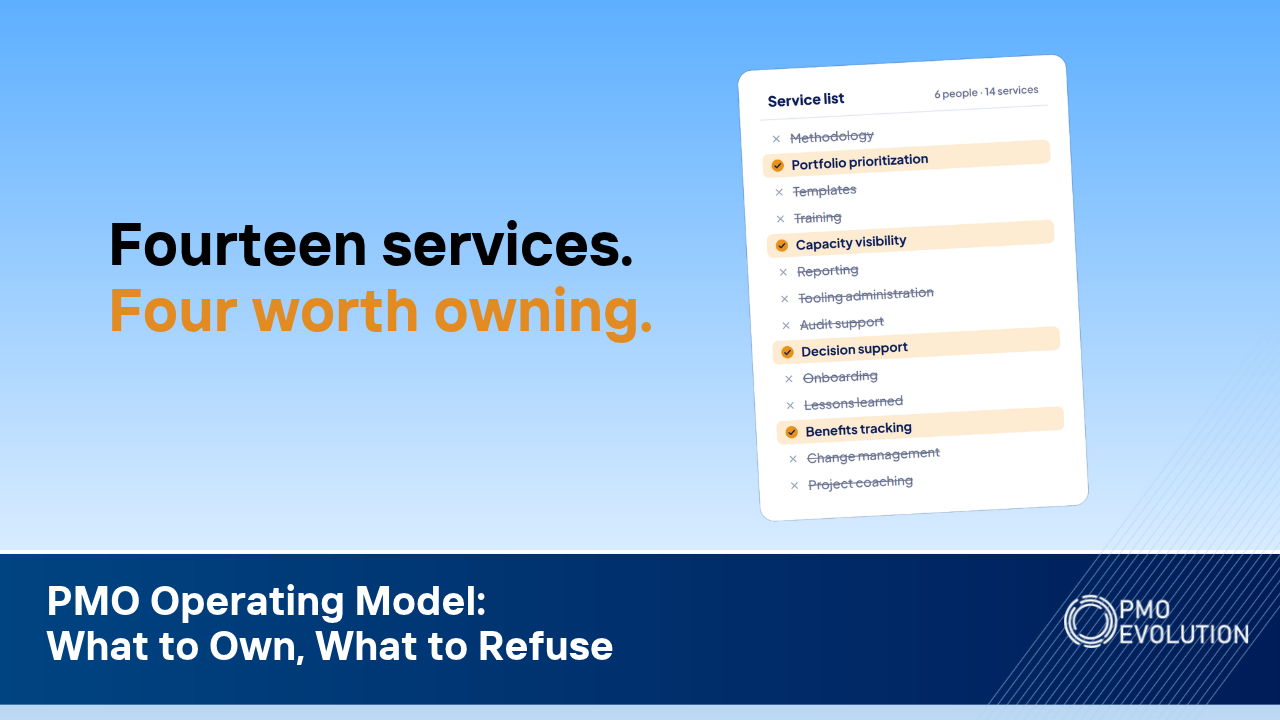

In a quarterly portfolio review two years ago, I asked 19 sponsors the same question, one at a time. What result in the next 90 days would make you stop your own project?
Two of the 19 answered with a number. Seventeen explained why the project mattered, and most did so well. Nobody was evading me. Nobody had been asked before. In that organization, every funding decision came with a start condition but no end condition, so 23 initiatives were running on business cases that had been argued once at approval and never tested again.
Gartner put a number on the same gap in October. In its research for 2027 CIO budgets, 31 percent of CIOs had set criteria for stopping weak AI pilots, and 17 percent had rules for abandoning low-value initiatives already running. The same research projects IT budgets growing by 3.7 percent next year, while agentic AI funding grows by 31.8 percent. The money for new work has to come from work already in flight, and five out of six organizations have no agreed-upon way to choose which work to give up.
Why do projects keep running after they stop making sense?
Three reasons, and I have watched all three operate in the same portfolio:
- The business case is argued once. Approval is the only moment the benefit, the cost and the assumptions behind them are examined together. After that the project reports progress, and progress is read as proof the case still holds.
- Percent complete is read as value. A project at 70 percent is treated as 70 percent of the way to a benefit. It is 70 percent of the way through a budget. Those are different facts, and portfolio reviews show only the first one.
- Stopping has a face and continuing has none. The sponsor who proposed the project attends the meeting where a stop is discussed. Nobody attends on behalf of the two queued initiatives that would start if the money moved. The decision is weighted before anyone speaks.
Project stop criteria fix all three because they shift the argument from the day of the decision to the day of funding, when nobody has anything to defend yet:
- Write three stop conditions at funding
Every initiative gets three conditions before money moves, written by the sponsor and recorded by the PMO.
- A benefit condition: the leading indicator the project must show by a date. This is an early signal that the end benefit remains plausible, since it arrives after go-live. For a self-service onboarding project, it read: by June 30, at least 40 percent of new accounts are opened without a branch visit in the two pilot regions.
- A cost condition: the forecast at completion above which the project returns to the board. We set it at 115 percent of the approved budget, so a project may run over, and it returns to the board when it does.
- An assumption condition: the external fact the case depends on. A regulation taking effect, a vendor contract renewing, a volume forecast holding. If the fact changes, the case is reopened.
Sponsors resist this for about ten minutes. Then they realize that a condition they wrote is a defence they control, and the resistance ends.
2. Give the stop decision an owner who is not the sponsor
The sponsor presents evidence against the three conditions. The decision belongs to whoever owns the funding pool, in our case the portfolio board chaired by the COO. The PMO prepares the comparison, not the verdict.
This separation is what makes the sponsor's position survivable. A sponsor who stops a project looks like someone who failed. A sponsor whose project met a stop condition the board had agreed to looks like someone who kept their word.
3. Test every initiative, every quarter, in one format
The quarterly portfolio review has one page per initiative with three rows: condition, evidence, verdict. The evidence is a number or a dated fact. The verdict is one of three words. Continue, Re-scope or Stop.
Continue means every condition holds and the project proceeds without discussion. Re-scope means a condition has failed and the sponsor proposes a smaller project that meets a revised condition within 60 days. Stop means a condition has failed and no credible re-scope exists.
The first quarter we ran this format across all 23 initiatives, the review took two hours and ten minutes. The previous format, a status walk-through, took a full day and had produced no stop decision in 18 months.
4. Name where the money and people go before you stop
A stop with no destination is a cut, and executives experience cuts as losses. A stop with a destination is a reallocation, and executives experience reallocations as decisions.
So the queue sits on the same page as the verdicts. Before the board votes to stop anything, the PMO shows the two or three queued initiatives that would start with the freed budget and the freed people, with their own three conditions already written.
In our second quarter, four of the 23 initiatives tripped a condition. Two stopped. One lost half its scope. One received 60 more days against a tighter benefit condition and met it. The two stops released 1.4 million dollars and five people, and two initiatives that had waited in the queue since January started within the same quarter.
5. Record the stop where you record the go-lives
A stop decision is a portfolio result. We recorded each one with the condition that failed, the evidence, the date and the destination of the released capacity, and we reported stops in the same monthly executive summary that reported go-lives.
Within a year, sponsors started bringing their own stop recommendations to the board before the review reached them. That was the point at which stop criteria stopped being a PMO process and became how the organization made decisions.
Where Smartsheet carries this
The portfolio sheet gets four columns: Benefit Condition, Cost Ceiling, Assumption Condition and Next Review Date. Control Center adds them to the intake form, so no project is provisioned without the three conditions filled in.
An automated workflow sends each sponsor an update request ten days before the review date, asking for evidence against each of the three conditions. The evidence arrives in the sheet, with the sponsor's name and a timestamp, before anyone builds a deck.
A report filters to initiatives whose evidence field is empty or whose verdict reads Re-scope or Stop. That report is the board agenda. A dashboard widget shows stops and re-scopes this year beside the money and people reallocated, so the executive team can see the portfolio freeing capacity for new work.
Do this next week
Take your five largest in-flight initiatives. Ask each sponsor what result in the next 90 days would make them stop. Write the answers down in their words. Count how many contain a number.
If the count is two or fewer, your portfolio is running on start conditions alone, and the 2027 budget conversation will be decided by whoever argues best on the day.
If you want stop conditions, a decision owner and the quarterly test in place across your whole portfolio, that is the kind of work the PMO Value Blueprint does in four to eight weeks. No sales pitch, a 30-minute conversation: calendly.com/pmoevolution
PS. The PfMP Accelerator opens in January 2027. Deciding which initiatives stop so others can start is portfolio management work, and that credential tests it. PMO Pulse subscribers get launch details first, so reply to this issue with the word PfMP if you want them.
PMI, PMI-PMOCP, PfMP and Authorized Training Partner are registered marks of the Project Management Institute, Inc.
Upcoming events
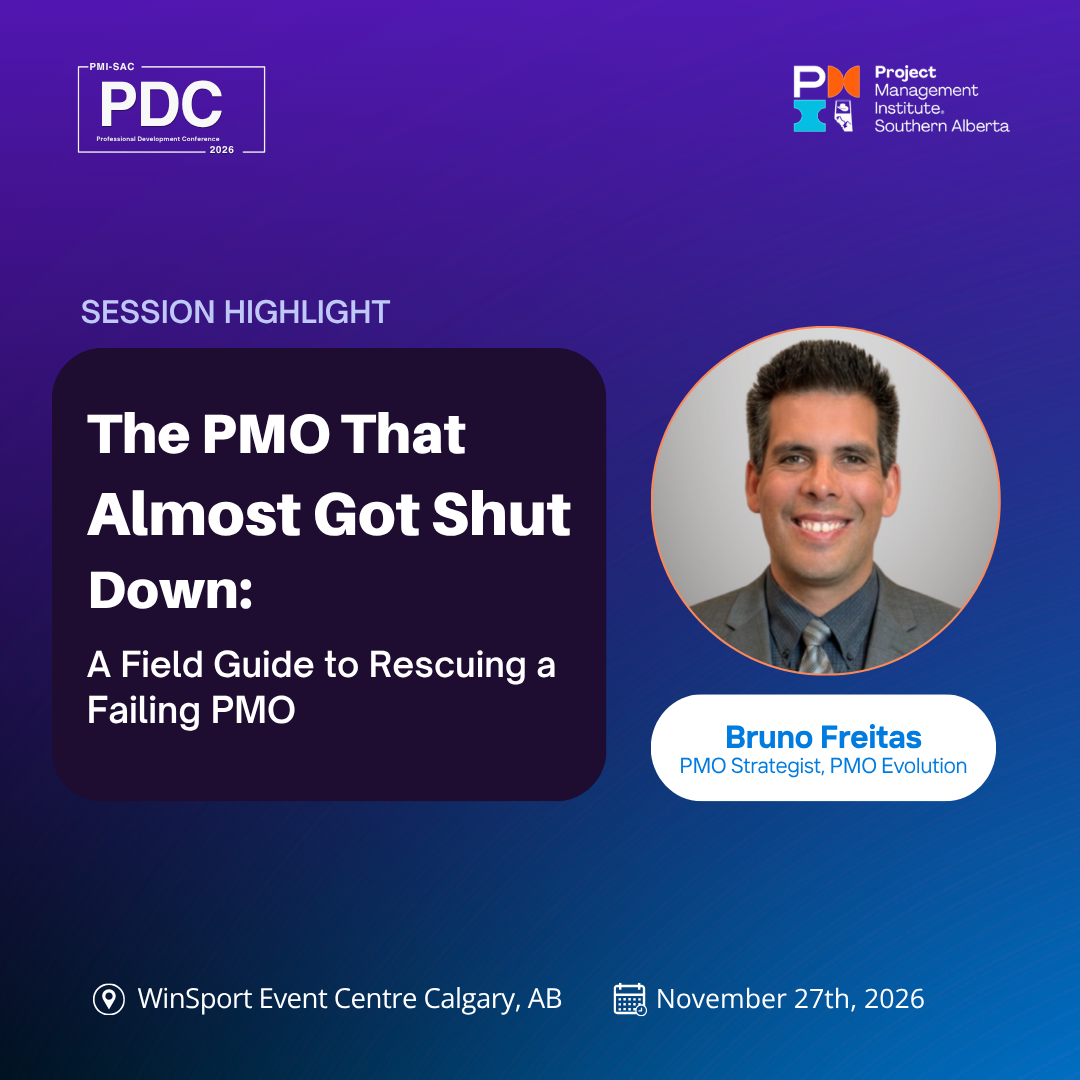
I'm excited to announce that I'll be speaking at the PMI SAC Professional Development Conference (PDC) 2026!
Join me for my session: The PMO That Almost Got Shut Down: A Field Guide to Rescuing a Failing PMO
📅 November 27, 2026
📍 WinSport Event Center
🔗 Register here: https://site.pheedloop.com/event/pmisac2026/home/
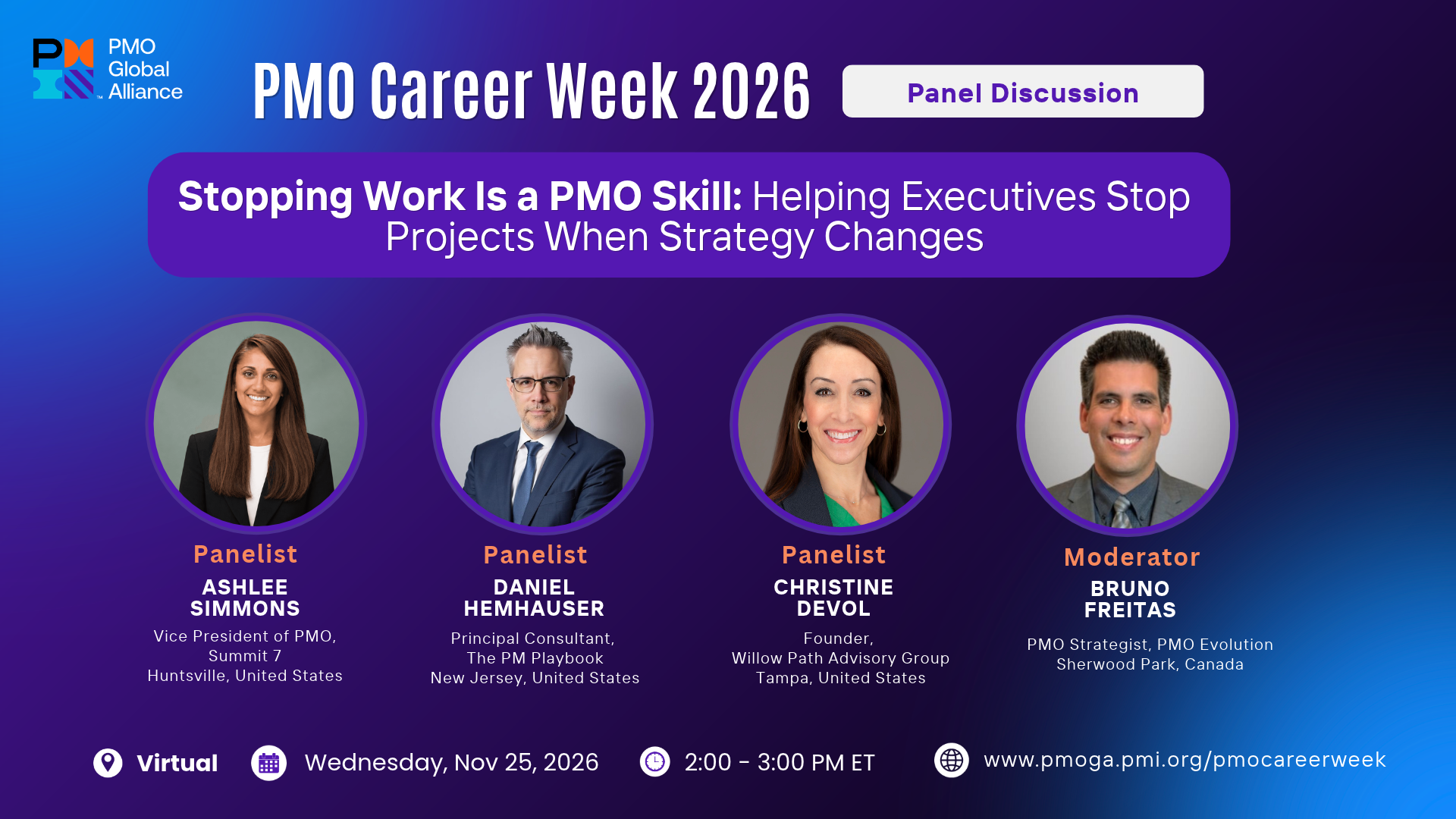
Bruno Freitas moderates a panel discussion at PMO Global Alliance's PMO Career Week 2026, with Ashlee Simmons, Daniel Hemhauser and Christine DeVol.
Stopping Work Is a PMO Skill: Helping Executives Stop Projects When Strategy Changes
Wednesday, November 25, 2026, 2:00 to 3:00 PM ET | Virtual
🔗 Register here: https://www.airmeet.com/e/bcd96350-b058-11f1-8445-9fbac49d23c4