
The afternoon our business cases stopped adding up
It was one of those budget seasons when I sat in a CFO's office with a calculator (yes, I am old school) and the 31 active business cases in our portfolio. I added up the annual benefits they promised. The total came to $46 million.
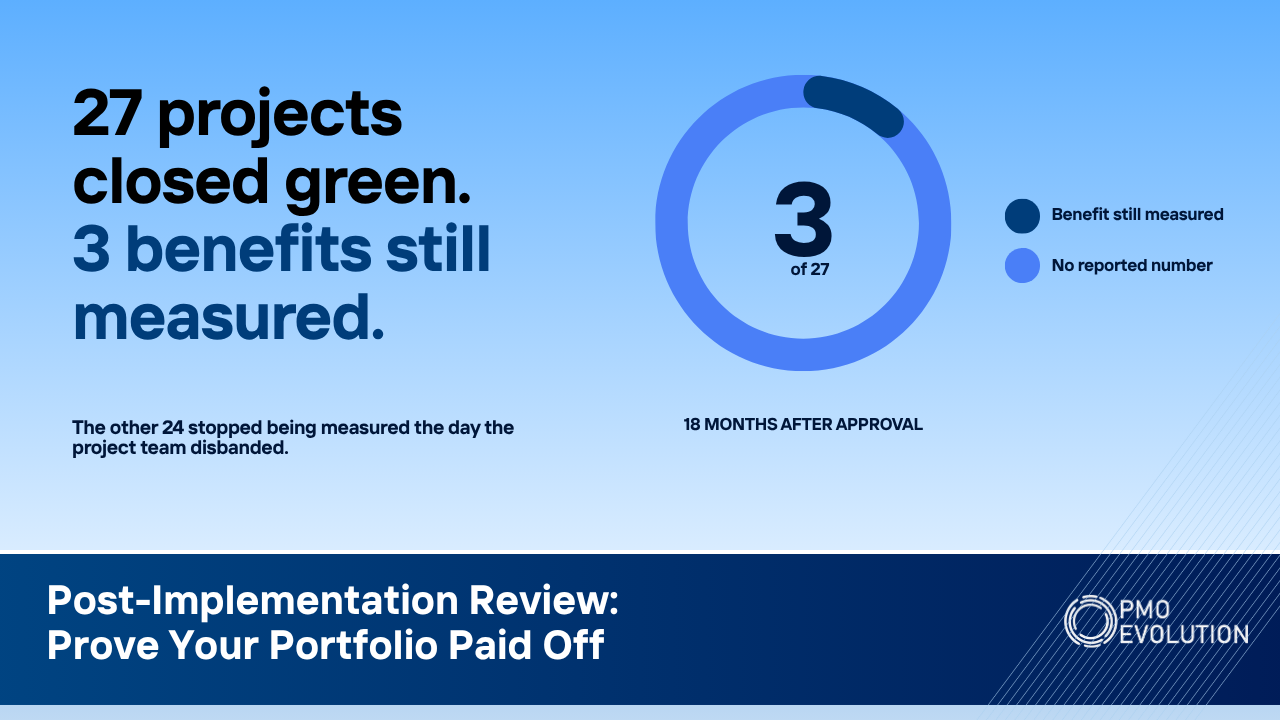
The CFO had done his own homework. He had asked finance to trace what the previous year's completed projects had actually returned, benefit by benefit, against the general ledger. They could verify $6 million. Not $40 million missing because of bad luck or a rough market. $40 million that had never existed anywhere except in approval documents.
Then he asked the question that changed how I run portfolio intake: why would I believe this year's number?
I did not have a good answer that afternoon. I have one now, and it is the reason benefits realization planning has to start at the moment of funding, not at project closure. This issue walks through the five disciplines I put in place afterward, in the order I would install them again.
Why do business case benefits disappear after approval?
Three reasons, and none of them is estimation skill.
First, most promised benefits never touch a ledger. A benefit that does not change a specific budget line is a story, and stories cannot be verified, so they are never checked.
Second, nobody owns the number. The project manager owns delivery. The sponsor owns approval. The person who will actually bank the saving twelve months later usually never saw the business case.
Third, the incentive structure rewards the promise, not the result. A business case author is celebrated at funding. By the time the benefit is due, the author has moved on, the baseline has shifted, and there is no one left who remembers what was committed.
None of this is fixed by better templates or bigger spreadsheets at closure. It is fixed at the funding gate.
Five disciplines that make benefits real before money moves
Discipline 1. Trace every benefit to a ledger line. Before funding, every hard benefit must name the budget line that will change, by how much, and from what baseline. If the case promises $1.2 million in reduced maintenance spend, I want the account, the current annual figure, and the target figure. If nobody can name the line, the benefit is reclassified as soft and comes out of the ROI math.
Discipline 2. Name one accountable benefit owner and get a signature. Not a department, one person, and never the project manager. The benefit owner is whoever controls the budget line that will move. Their signature on the business case means they agree to report the result against the baseline when the checkpoint comes. The first quarter we required signatures, our total promised benefits dropped by roughly a third. Nothing real was lost. The fiction evaporated and people started taking this seriously.
Discipline 3. Separate hard, soft, and strategic benefits, and run ROI on hard dollars only. Soft benefits are real. Faster cycle times, better decisions, happier customers all matter. But they are not cash, and blending them with cash in a single ROI figure is how a portfolio ends up promising $46 million it cannot find. Label all three types, report all three types, and fund against the hard number.
Discipline 4. De-duplicate benefits across the portfolio. Business cases are written one at a time, but benefits land in one company. When we consolidated our benefit lines, we found savings claimed by two different projects more than once, including the same warehouse headcount reduction counted twice. A portfolio-level benefits view is the only place double counting becomes visible.
Discipline 5. Schedule the first benefits checkpoint at funding, not at closure. The checkpoint date, the owner who will present, and the baseline they will present against all go into the funding decision itself. Waiting until closure to plan realization is why realization never happens. By closure the baseline is stale, the owner has changed roles, and the organization has 30 newer promises to be excited about.
What changed in the next funding cycle
The first visible effect was shrinkage. Promised benefits across the portfolio came down hard once signatures and ledger lines were required, and I had to stand in front of executives and explain why a smaller number was good news. The explanation held: nothing real had been removed. The gap between the old total and the new one was the fiction we had been funding all along, and every dollar of it had been taxing our credibility without anyone noticing.
The second effect was speed. Funding meetings got shorter, because a benefit with a named owner and a documented baseline does not get relitigated. The committee stopped debating whether numbers were real and started debating what actually deserves executive attention: sequence, capacity, and risk.
The third effect took two quarters to arrive, and it was the one that mattered. When the first checkpoints came due, benefit owners showed up and reported against their baselines, because the reporting date had been on their calendar since funding day. For the first time, the portfolio's value story was built from verified figures, and the CFO who had asked the original question became the strongest sponsor the PMO had.
Where Smartsheet fits
Every one of these disciplines lives or dies on whether the commitments survive outside meeting minutes. We hold ours in a portfolio benefits register in Smartsheet: one row per benefit line, with columns for type (hard, soft, strategic), ledger line, baseline, promised delta, benefit owner, signature date, and first checkpoint date. Control Center rolls the register up across every program, so double counting surfaces the day a duplicate line is entered, not a year later. Automated reminders go to the benefit owner 30 days before each checkpoint, and the executive dashboard shows one chart that matters: promised versus verified, by quarter. That is the chart that rebuilt our credibility with the CFO who asked the question.
Your one action for next week
Pull your three largest active business cases. For each one, ask two questions: which ledger line moves, and who signed for it? If you cannot answer both in five minutes, your 2027 portfolio is being funded on promises, and budget season is the best possible moment to change that.
If you want a second set of eyes on your funding gate before 2027 locks, that is exactly what the Assess step of our Vision2Value Framework does. The PMO Value Blueprint is a focused 4 to 8 week engagement that maps where your benefits discipline leaks value and what to fix first. No sales pitch, a 30-minute conversation.

Click the image to book a call

Upcoming Live Session
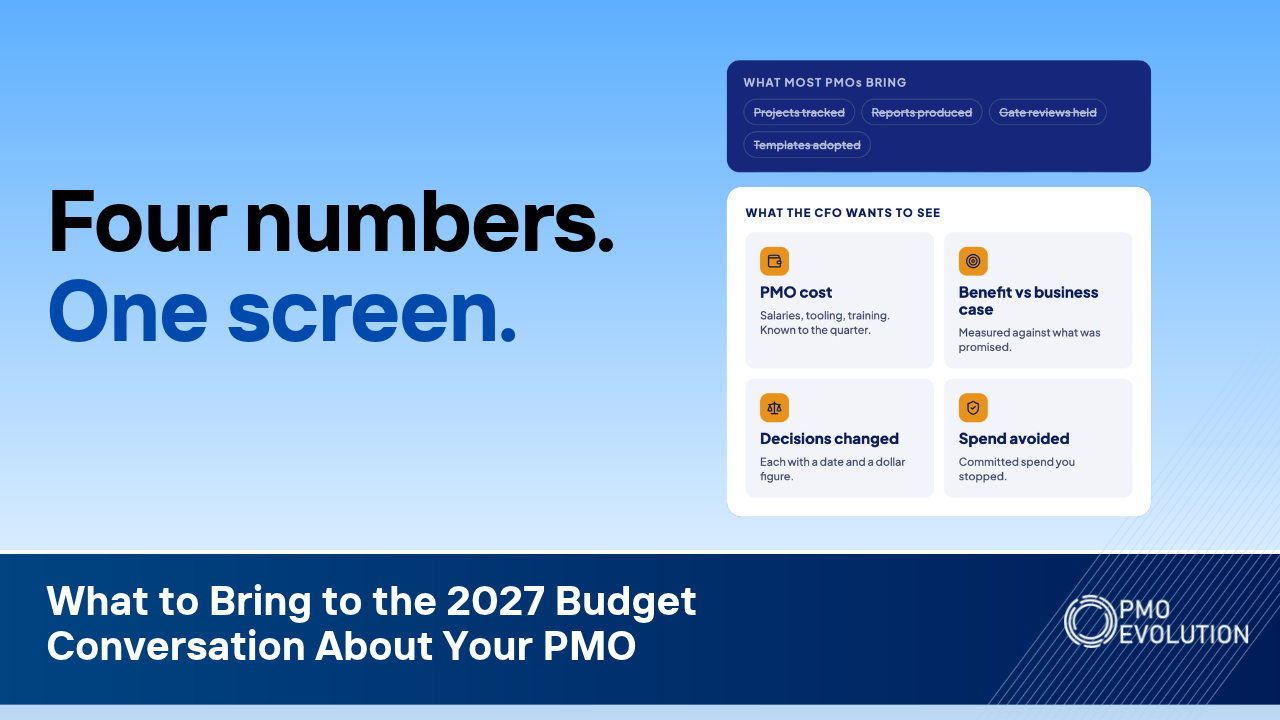
What would your company actually lose if the CFO cut your PMO budget in half?
Most PMO leaders cannot answer that in the CFO's language. This free 2-hour working session helps you build the answer yourself. It is not a webinar. Instead of watching slides, you work through the Helix Renewables case in small breakout groups: a $900M company, a new CFO, and 30 days to prove the PMO deserves its budget.
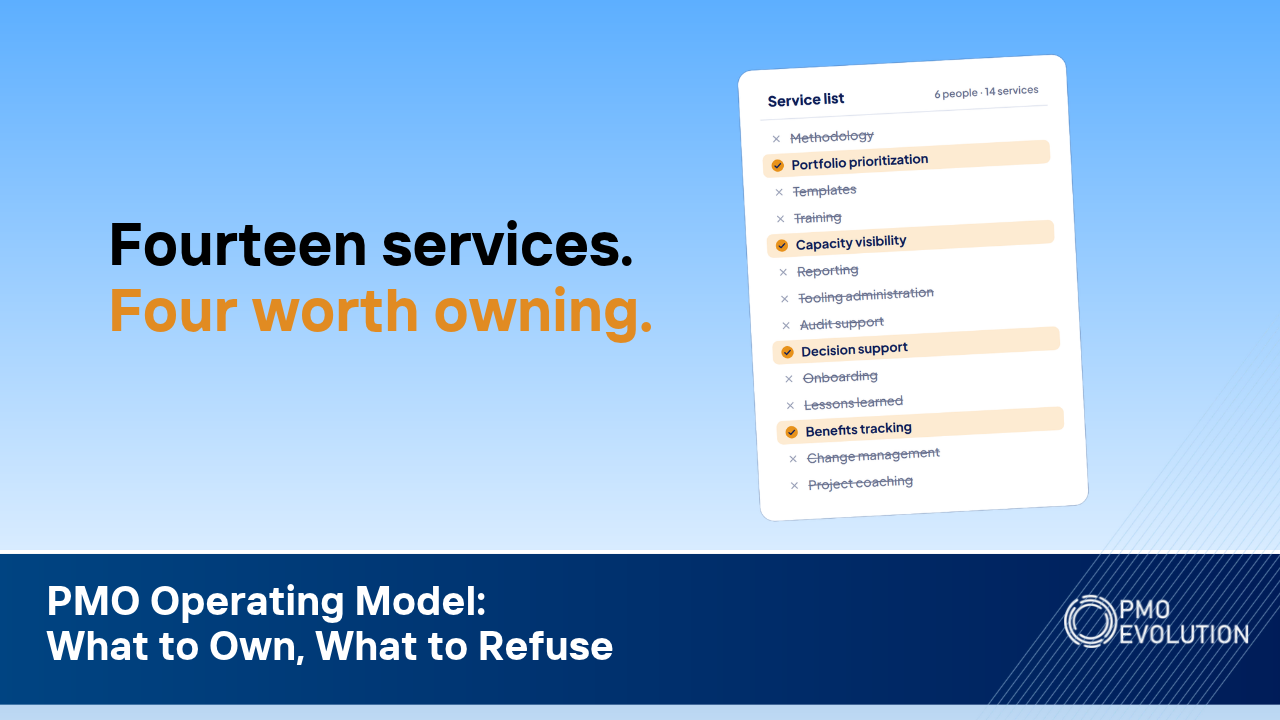
You leave with three finished deliverables: a stakeholder value map, a redesigned service mix (including the two things this PMO must stop doing), and the three metrics that hold up in a boardroom. After each round, Bruno walks through the model answer.
Led by Bruno Freitas (Founder and CEO, PMO Evolution) and Dr. Tony Prensa (Founder and CEO, TP Global Business Consulting), a contributing expert to PMI's PMO Practice Guide.
When: Wednesday, September 16, 1:00 to 3:00 PM Eastern (11:00 AM Mountain). Live only, free, registration required. Your workbook arrives as soon as you register.