
The afternoon we sorted 38 projects into three piles
A few years ago we printed every project one-pager in my portfolio, took over a conference room, and spent a Friday afternoon sorting 38 projects into three piles on the table. Run the business. Grow the business. Change the business. No committee, no scoring model, no tool. Paper and two hours.
The portfolio was $54 million in annual spend. The corporate strategy deck used the word transformation fourteen times. Here is how the piles came out: 31 projects and roughly $44 million sat in the run pile. Five projects were growing something we already did. Two projects, about $3 million, were doing anything the strategy deck would recognize as transformation. Eighty-one percent of the money was keeping the lights on, and six percent was funding the future the executives kept describing on town halls.
Nobody had lied to anyone. Every one of those 38 projects had a signed business case and a named sponsor. The portfolio had drifted there one reasonable approval at a time. Three weeks later I put those three percentages on a single slide in front of the steering committee, next to a quote from their own strategy document. That slide changed next year's funding conversation more than any status report I ever produced.
Why every portfolio drifts toward run-the-business
This drift is not a failure of discipline. It is the default physics of project approval, and it works the same way in every industry I have led portfolios in.
Run-the-business work always arrives with urgency attached. A system is going out of support. A regulator set a date. A process is breaking under volume. Saying no has a visible, near-term cost, so run work wins almost every individual funding decision. Transformation work carries the opposite profile: the benefit lands next year or the year after, the sponsor is asking rather than demanding, and delaying it costs nothing anyone can see this quarter.
So each approval is defensible on its own, and the sum is an accident. No executive ever decided to spend 81 percent of the portfolio on maintenance. They decided 38 separate times to fund something reasonable, and nobody ever priced what the decisions added up to. That is the gap portfolio categorization closes. It does not judge any single project. It prices the sum.
What should a healthy portfolio mix look like?
There is no universal ratio, and be suspicious of anyone selling one. A utility in a heavy regulatory cycle will run hot on run-the-business spend, and it should. A company whose strategy depends on entering new markets cannot fund that ambition on six percent of project spend, no matter what its slides say.
A healthy mix has two properties. First, it matches the strategy in force: if the strategy claims transformation, the transform bucket holds enough money and scarce capacity for that claim to be arithmetically possible. Second, it was chosen on purpose: the executive team saw the current percentages, debated them, and set targets.
Five steps to categorize your portfolio before 2027 funding
You can complete the first pass of this before your funding cycle locks, and most of it in a week.
Step 1. Define the three buckets in business language, one sentence each, and get executive sign-off on the definitions before you categorize anything. My working versions: run protects the revenue and operations we have today. Grow produces more of something we already do well. Transform builds a capability the company does not have. The definitions matter more than the labels, because every argument you will have later is really an argument about definitions.
Step 2. Categorize every active project in a single pass. One afternoon, the portfolio team, gut calls first. Force one bucket per project, no splits and no fourth bucket, because the moment you allow a project to be 40 percent transform, every sponsor will discover their maintenance work is 40 percent transform. Then let sponsors challenge the calls against the signed-off definitions, not against their preferences.
Step 3. Price the buckets. Percent of annual spend per bucket, not count of projects. Thirty-one small projects and two large ones tell opposite stories depending on which lens you use, and money is the lens executives act on. If you can add percent of scarce senior capacity per bucket, do it, because people drift faster than dollars. In my sort, the two transform projects held plenty of budget on paper and almost none of the senior people who could actually deliver them, and the capacity view exposed that before the budget view did.
Step 4. Put the mix on one slide next to the strategy statement, and stop talking. Do not recommend anything in the first meeting. The distance between what the strategy says and where the money goes is the conversation, and executives need to have it with each other, not with you. Your job is to make the gap undeniable.
Step 5. Set a target mix for 2027 and wire it into intake. Every new request declares its bucket before it reaches a funding decision, and the portfolio review tracks actual mix against target quarterly. Without this step the drift starts again the Monday after your slide.
Where Smartsheet fits
This is one of those disciplines where the tooling cost is almost nothing. On the portfolio sheet of record, the entire model is a single dropdown column: Run, Grow, Transform. The intake form gets the same field, so no request enters the pipeline unclassified. A stacked chart on the executive dashboard shows spend by bucket against the 2027 target, and if you run Control Center, the category rides the project metadata so every new project inherits the discipline on day one. I have watched a client stand this up in a morning. The hard part was never the build. It was deciding to look.
Your move next week
Print your active project list. Book a conference room for one afternoon. Sort every project into run, grow, or transform, price the three buckets as percent of spend, and put the percentages next to one sentence from your strategy document. Do not wait until the categories are perfect; a defensible first pass beats a precise model that arrives after 2027 funding locks.
If you want a second set of eyes on what the sort reveals, that is exactly the kind of question the PMO Value Blueprint exists to answer: a focused 4 to 8 week engagement on your real portfolio, often including a Smartsheet pilot. Or start smaller. Book 30 minutes at calendly.com/pmoevolution.
Click the image to book a call
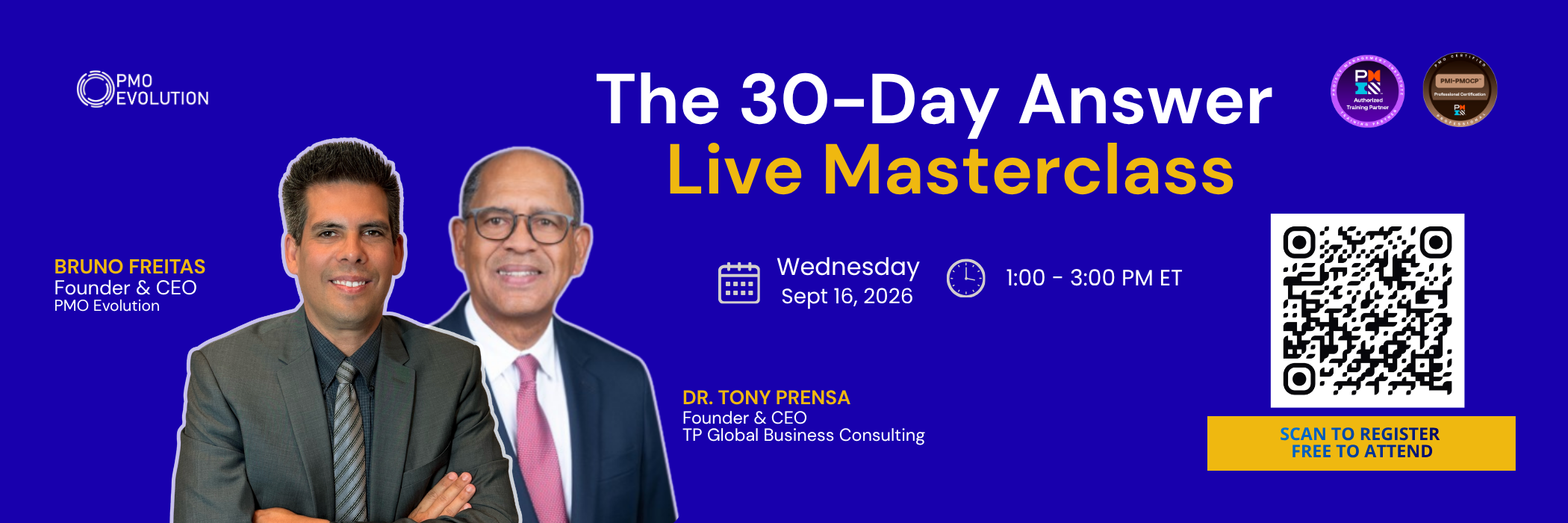
Upcoming Live Session
Most PMO training tells you what a value story should contain. On Sept 16, you will actually build one.
The 30-Day Answer is a free two-hour live session from Bruno Freitas and Dr. Tony Prensa, built around one scenario: Helix Renewables, where the CFO has given the PMO 30 days to prove it adds value to the organization.
Working in small breakout groups with other PMO leaders, you take that company from flagged for defunding to a defensible rescue plan, using the PMO flywheel from PMI's PMO Practice Guide.
You leave with the plan you built, the thinking behind it, and a much clearer picture of what your own PMO's answer would need to look like.
📌 Grab your seat for The 30-Day Answer