
PMO Governance: Decision Rights Over Gatekeeping
The committee that decided nothing
The steering committee had been in the room for ninety minutes and decided nothing. I was there as an observer, brought in to find out why a transformation program kept slipping. Twelve people sat around the table, three of them executives whose hour costs more than some of the projects on the agenda. They worked through a status pack one slide at a time. Every time a real choice surfaced, whether to fund the data migration, whether to pull two engineers off a stalled initiative, the room agreed to take it offline. The only decision made all morning was the date of the next meeting.
That committee had governance. Binders of it. A gate model, intake forms, a RACI chart taped to the wall, a monthly cadence that never missed. What it did not have was the right to decide. Not one person in that room could approve a funding change without calling someone who was not there. So nothing moved.
Here is what I tell every PMO leader who asks me to fix their governance. Governance is not a stack of forms and gates. It is the answer to one question: who gets to decide what, with what information, by when. When you confuse process with governance, you build a toll booth that everyone learns to route around. When you design decision rights, you build a fast lane the business actually wants to use.
Why is your PMO governance slowing everything down?
Most PMO governance grows by accretion. A project fails, so someone adds a checkpoint. An executive gets surprised, so someone adds a report. A vendor contract goes sideways, so someone adds an approval. Five years later you have a forty-step intake process and a steering committee that rubber-stamps decisions already made in hallways. The process is busy. The decisions are slow.
The cause is almost always the same. The governance was designed around documents, not decisions. Forms tell people what to submit. They do not tell anyone what they are allowed to decide. So every choice climbs the ladder looking for an owner, and the people with real authority spend their time reviewing things three levels below their pay grade while the actual trade-offs wait.
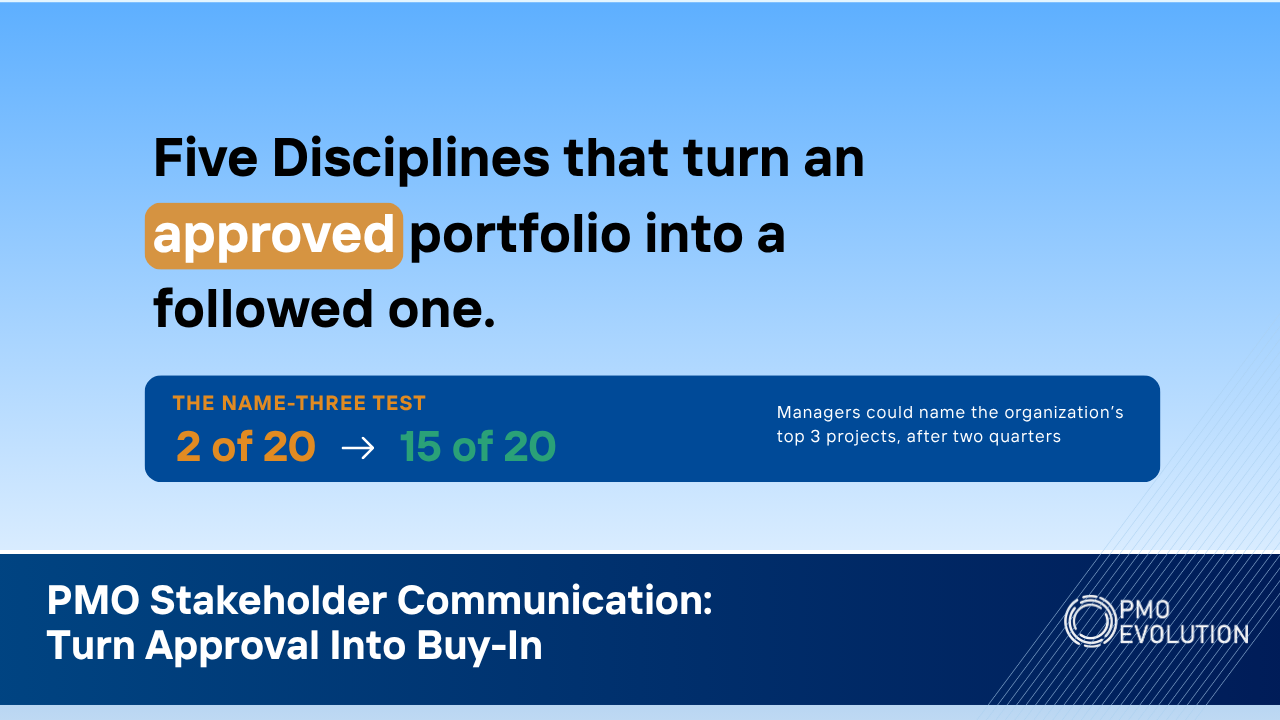
I have rebuilt governance for portfolios north of 100 million dollars, and the pattern that works is the opposite of adding steps. You strip governance back to decisions, give each decision an owner and a time limit, and let the paperwork serve the decision instead of the reverse. Five disciplines make that real.
Five disciplines for governance that decides
1. Map decisions before you map forms.
List the decisions your portfolio actually requires. Approve a new initiative. Change a budget over a threshold. Stop a project. Reallocate a scarce resource. Resolve a cross-project dependency. For each one, name the single role that owns it and the threshold where it escalates. When I run this with a client, the list is shorter than they expect, usually fifteen to twenty decisions that run the whole portfolio. Everything else is noise dressed up as governance.
2. Tier your work so not everything goes through the same gate.
A 50,000 dollar process improvement and a 12 million dollar platform replacement do not need the same governance. Categorize initiatives by size, risk, and strategic weight, then give each tier its own path. Small, low-risk work gets a light touch and a fast yes. Large, high-risk work gets the full committee. This is portfolio categorization doing real work, not a label on a spreadsheet, and it is where most PMOs recover the most time, because they stop running every idea through the heavyweight process.
3. Make intake a value filter, not a queue.
Intake is where governance earns or loses its credibility. A weak intake collects requests and forwards them. A strong intake asks the questions that decide: what business problem does this solve, what is the expected benefit and how will we measure it, what does it depend on, what does it displace. If a request cannot answer those, it does not enter the portfolio. That one discipline kills more bad work than any steering committee, because it stops the bad work before it has a sponsor and a sunk cost defending it.
4. Put the data in front of the decision, not after it.
Most governance meetings spend their first half rebuilding context. Where are we, what changed, what is at risk. By the time the room is oriented, the energy to decide is gone. Flip it. The decision owner walks in with the portfolio status already in view, so the meeting is spent on the choice, not the catch-up. This is where Smartsheet earns its place for the clients I work with. A live portfolio dashboard, fed by the project registers and refreshed automatically, puts the funding picture, the capacity picture, and the risk picture on the screen before anyone speaks. Control Center rolls the same view up across the portfolio, so the executive owning a decision sees the same numbers as the project. The meeting becomes a decision, not a status read-out.
5. Put a clock on every decision.
A decision right with no deadline is a suggestion. For each decision in your map, set the window it must be made in: a funding change within five business days, an escalated dependency within forty-eight hours, an intake review within one cadence. When a decision blows its clock, it escalates automatically. This is what turns a governance model from a description into a machine. People stop waiting for the next monthly meeting to move, because the model gives them a path and a deadline.
What changes when you do this
The first thing PMO leaders notice is that the steering committee gets shorter and the decisions get faster. The second is that the business stops routing around the PMO, because the fast lane is now faster than the back channel. The third, and the one that protects your seat at the table, is that executives start to trust the office. They trust it because it is where decisions get made on time with good information, not where requests go to wait.
None of this requires a bigger team or a new tool. It requires the discipline to treat governance as a decision system and to design it on purpose, rather than letting it grow one checkpoint at a time. The PMOs that do this run leaner and move faster than the ones twice their size still adding forms.
Your move next week
Pick the five decisions your portfolio makes most often. For each one, write down who owns it today, who should own it, and how long it should take. You will find at least one decision that nobody owns and at least one that sits two levels too high. Fix those two before you touch anything else. That is governance work that pays off in a week, not a quarter.
If you want a second set of eyes on your governance model, that is the kind of work we do inside the PMO Value Blueprint, a focused three to eight week look at where your portfolio leaks time and value. No sales pitch, a real thirty-minute conversation to start.
Book it at calendly.com/pmoevolution