
The go-live party had a cake
I still remember the cake. A $3M system, delivered on time and on budget, and the team earned that celebration. The steering committee marked the project green, closed it, and moved on. Ninety days later, I pulled the usage report before a quarterly review. Fourteen percent of the target users had logged in that month. Not fourteen percent short of target. Fourteen percent, total.
The CFO asked me one question in that review: Where is the $1.1M in annual savings we approved this for? I did not have an answer because the savings did not exist. The system existed. The savings were supposed to come from people working differently, but they weren't. We had celebrated a launch and skipped the landing.
That project changed how I run portfolios more than any success ever did. It taught me that PMO change management is not a workstream you staff at the end of a project. It is a portfolio discipline, and when the PMO does not own it, nobody does.
Why do delivered projects fail at adoption?
Because we fund launches and assume landings. Look at how accountability is structured on most projects. The project manager is accountable until go-live. The business case is built on benefits that only show up after go-live. Between those two points sits the adoption gap, and in most organizations, it has no owner, no budget, and no place in the portfolio report.
Delivery success and adoption success are different results. Delivery success means the thing was built as specified, on schedule, within budget. Adoption success means people have changed how they work as a result. The first is fully within the project team's control. The second depends on sponsors, line managers, workload, timing, and whether the old way of working was ever actually switched off. Your status reports measure the first. Your benefits depend entirely on the second.
Here are the five disciplines I now build into every portfolio to close that gap.
1. Define done as adopted, not delivered
The fix starts in the business case, not at go-live. If a project is funded on benefits, it should close on adoption. Every business case in the portfolio includes an adoption target next to cost and schedule: for example, 70 percent of target users actively using the new system by day 90. The project does not reach its final gate until that number is measured. Not achieved, necessarily, but measured and owned. The moment you write adoption into the definition of done, every downstream conversation changes.
2. Name an adoption owner on the business side
The project manager cannot own the adoption, because the project manager leaves. Adoption belongs to the person who runs the function where the change lands, named in the charter by name, not by role. That person owns the adoption number the way a cost center owner owns spend. When the day 60 report shows usage stalling, there is one person the steering committee looks at, and that person has the authority to act inside the business, where the PM never could.
3. Check change capacity before you schedule go-live
Organizational change management fails most often for a reason no training plan can fix: the receiving team was already saturated. I have watched a single operations group absorb a new CRM, a reorganization, and a finance system cutover in the same quarter. All three projects were green. The team was drowning. The portfolio should hold a simple change calendar showing which groups are hit by which go-lives and when. If three land on one team in one quarter, the portfolio moves a date. That single view prevents more adoption failures than any communications plan I have ever seen.
4. Give the old way a retirement date
People do not adopt a new system while the old one still works. As long as the legacy spreadsheet is alive, the new platform is optional, and optional loses to habit every time. Every implementation plan should name the date the old process is switched off, and that date belongs in the project plan with an owner, the same as any milestone. If you cannot retire the old way, say so in the business case, because your benefits number is about to get smaller.
5. Run 30, 60, and 90 day adoption checkpoints
After go-live, three short checkpoints, each 30 minutes, each producing one number for the portfolio report.
- Day 30: what share of target users have access and have logged in.
- Day 60: what share are doing their core tasks in the new way, and how many old-process workarounds are still running.
- Day 90: adoption against the business case target, and whether benefits realization is still credible.
The portfolio report carries an adoption column beside cost and schedule. What gets reported gets managed, and adoption is no exception.
One warning before the tooling: these five disciplines are portfolio disciplines, not project add-ons. If you bolt them onto individual projects one at a time, each project team will trade them away under schedule pressure, the same way quality reviews get traded away. The PMO holds them as standing rules of the portfolio: no business case without an adoption target, no charter without an adoption owner, no go-live date without a capacity check. That is what makes organizational change management a capability instead of a workstream, and it is the difference between a PMO that reports on projects and one that answers for outcomes.
Where Smartsheet makes this real
This is one of those disciplines where the tooling is the easy part, which is exactly why there is no excuse to skip it. In Smartsheet I set up an adoption metrics sheet with one row per go-live and columns for the 30, 60, and 90 day targets and actuals. Date-triggered automation sends an update request to each adoption owner at every checkpoint, so the data collects itself. A formula flags any project running below 80 percent of its adoption target, and the portfolio dashboard shows the adoption column right beside cost and schedule. On larger portfolios, a portfolio dashboard rolls the same structure across every program, so the adoption conversation happens at portfolio level, where dates and capacity can actually be moved.
Your one action for next week
Pull the last three projects your portfolio closed. For each one, ask the receiving business unit a single question: how many of the intended users are working the new way today? If nobody can answer within a day, you have found your adoption gap, and you now know exactly where your benefits are leaking.
If you want a second set of eyes on it, this is the kind of gap our PMO Value Blueprint is built to find in four to eight weeks. Book a 30-minute conversation at pmoevolution.com/contact.
NEXT LIVE SESSION
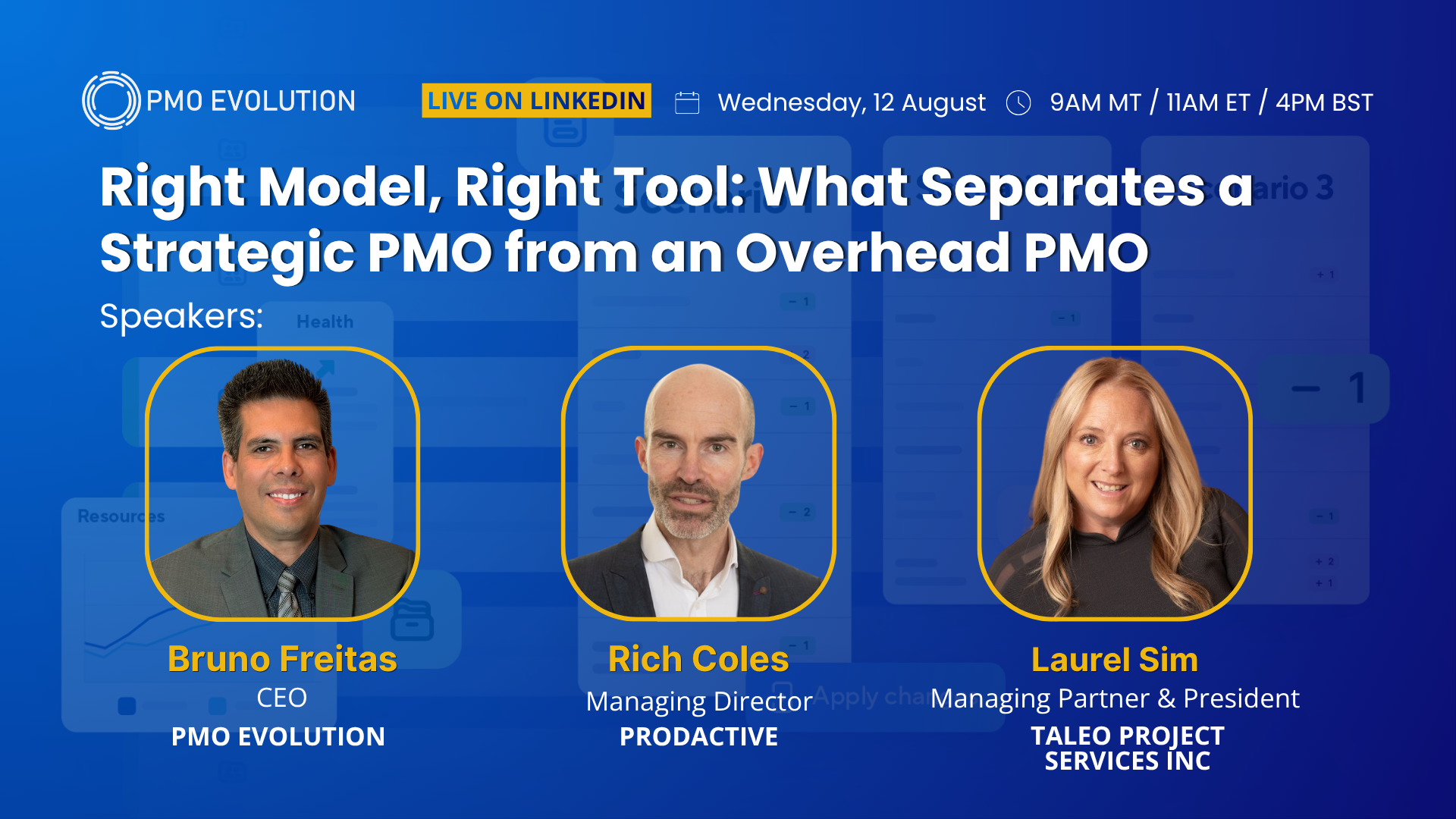
Right Model, Right Tool: What Separates a Strategic PMO from an Overhead PMO
Live on LinkedIn, Wednesday, August 12 at 9AM MT / 11AM ET / 4PM BST
I'm bringing together two people who have built and fixed PMOs from very different vantage points: Rich Coles, Managing Director of Prodactive, and Laurel Sim, Managing Partner and President of Taleo Project Services Inc. Together we'll unpack what separates a strategic PMO from an administrative one, why the operating model has to come before the tool decision, and where Smartsheet honestly fits against other PPM solutions. If you're evaluating your next PPM investment, this session will help you make that call with clear eyes.