
Why Your PMO's AI Strategy Is Failing (And What to Do About It)
Let me be blunt: most PMOs are getting AI wrong. Not because the technology isn't ready, but because the approach is backwards.
I was on a call a week or so ago with a PMO director at a mid-size company. She told me her CIO had handed down a mandate: "Get AI into every project workflow by Q3." No budget increase. No data cleanup initiative. No clarity on what problems AI was supposed to solve. Just a deadline and an expectation.
If you're a PMO leader right now, you're probably feeling this pressure from at least two directions. Your executives want you to "leverage AI" because every board presentation mentions it. And your project managers want to know what tools they should be using because they're tired of hearing the hype without seeing practical applications.
The PMOs that are actually making progress with AI are the ones taking a step back and asking a simple but critical question: What specific decisions do we need AI to help us make better?
A PRACTICAL FRAMEWORK FOR PMO AI ADOPTION
In the Vision2Value Framework, we talk about three layers: Portfolio Definition, Portfolio Delivery, and Benefits Realization and Sustainment. AI can add value at each layer, but only when you're clear about the decision you're trying to improve.
At the Portfolio Definition layer, AI can help you with demand scoring and prioritization. Instead of relying on gut feel or political influence to decide which projects make the cut, you can use predictive models that analyze historical data on project success rates, resource availability, and strategic alignment. But here's the catch: this only works if you've been capturing that data consistently. If your project intake process is a mess of emails and spreadsheet attachments, AI won't magically fix that.
At the Portfolio Delivery layer, the most practical use case I'm seeing right now is predictive risk flagging. Tools like Smartsheet are starting to incorporate AI features that can scan across your project data and flag patterns that historically correlate with schedule slippage or cost overruns. One PMO we work with reduced their surprise escalations by about 30% in six months just by implementing basic predictive analytics on their existing Smartsheet data. Nothing fancy. They just got disciplined about data entry and let the tool do the pattern matching.
At the Benefits Realization layer, AI can help you connect the dots between project outputs and business outcomes. This is where most PMOs drop the ball entirely, AI or not. If you're not tracking whether completed projects actually delivered the benefits that justified their funding, you're flying blind. AI can help automate some of that tracking, but again, you need the data foundation first.
THE DATA READINESS PROBLEM NOBODY WANTS TO TALK ABOUT
THE DATA READINESS PROBLEM NOBODY WANTS TO TALK ABOUT
Here's a statistic that should make every PMO leader pause: only 14% of IT leaders report high confidence that their content and data are properly governed for AI. And 57% of CIOs say data preparedness is a significant issue or dealbreaker for AI value.
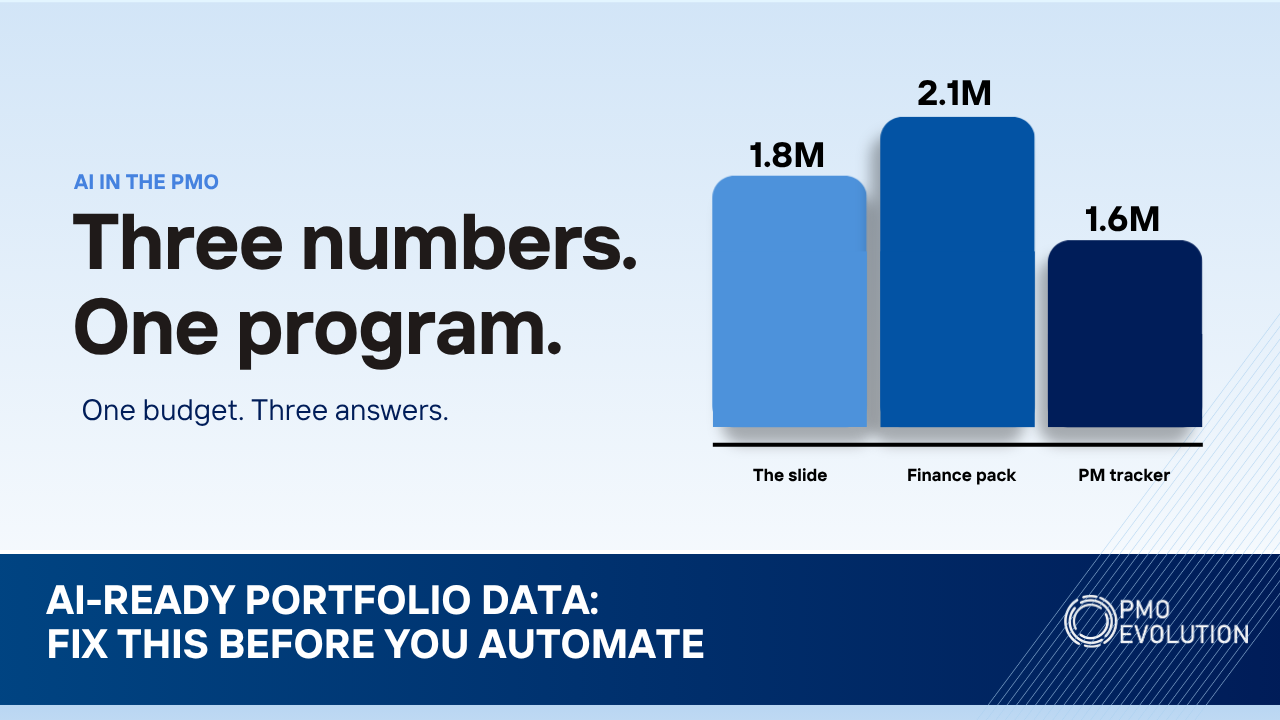
Translation: most organizations are trying to run AI on dirty, inconsistent, siloed data. And PMOs are often the worst offenders because we've spent years letting project managers track things "their way" in whatever tool they preferred.
If you want AI to work in your PMO, start with data governance. That means standardized project taxonomies, consistent status reporting cadences, clean resource data, and a single source of truth for portfolio information. I know that's not as exciting as demoing a new AI chatbot, but it's the work that actually matters.
THREE THINGS YOU CAN DO THIS QUARTER
First, audit your data readiness. Pick one portfolio report and trace every data point back to its source. How many manual handoffs are there? How many times does data get re-keyed? Where are the gaps? This exercise alone will show you exactly where AI could help and where you need to clean up before AI can do anything useful.
Second, start with one high-value use case. Don't try to "AI-ify" everything at once. Pick the one decision that costs your organization the most when it's wrong. For many PMOs, that's project prioritization or resource allocation. Build a pilot around improving that one decision with better data and simple analytics. You don't even need fancy AI tools for this step. Sometimes a well-structured Smartsheet sheet with the right formulas gets you 80% of the way there.
Third, invest in your team's data literacy. Your project managers don't need to become data scientists, but they do need to understand why clean, consistent data entry matters. They need to see the connection between the fields they fill in today and the insights the PMO can generate tomorrow. Make it tangible. Show them a before-and-after of what portfolio reporting looks like with clean data versus messy data.
THE BOTTOM LINE
AI is not going to replace your PMO. But a PMO that learns to work with AI effectively will outperform one that doesn't. The key is to resist the pressure to adopt AI for its own sake and instead focus on the fundamentals: clean data, clear use cases, and a phased approach that builds capability over time.
The PMOs that win in 2026 and beyond won't be the ones with the most sophisticated AI tools. They'll be the ones that got the boring stuff right first.
If you're feeling the pressure to "do something with AI" but aren't sure where to start, you're not alone. That's a conversation I'm having with PMO leaders every single week. If it would help to talk through your specific situation, I'm happy to connect.
Visit our website: pmoevolution.com
Follow us on LinkedIn: PMO Evolution
Subscribe on YouTube: PMO Evolution