
The Mid-Year Portfolio Review That Most PMOs Are Skipping
A few years back, I was working with a PMO Director at a mid-size company. Smart leader. Disciplined PMO. They ran a clean quarterly portfolio review every cycle. Colour-coded dashboards, executive summaries, the works.
Then in early May, I asked her one question. “Of the 47 active initiatives in your portfolio right now, how many are still tied to the strategic priorities your CEO announced in January?”
She paused. Then she pulled up the list and started going through it. About fifteen minutes later, she looked up and said, “We’ve got nine projects that don’t really map to anything anymore.”
Nine projects. Real budget. Real people. No real reason for being there.
That conversation is the reason I push every PMO leader I work with to run what I call a mid-year portfolio reset. Not a status review. A reset. They sound similar. They are not the same thing.
The difference between a status review and a mid-year reset
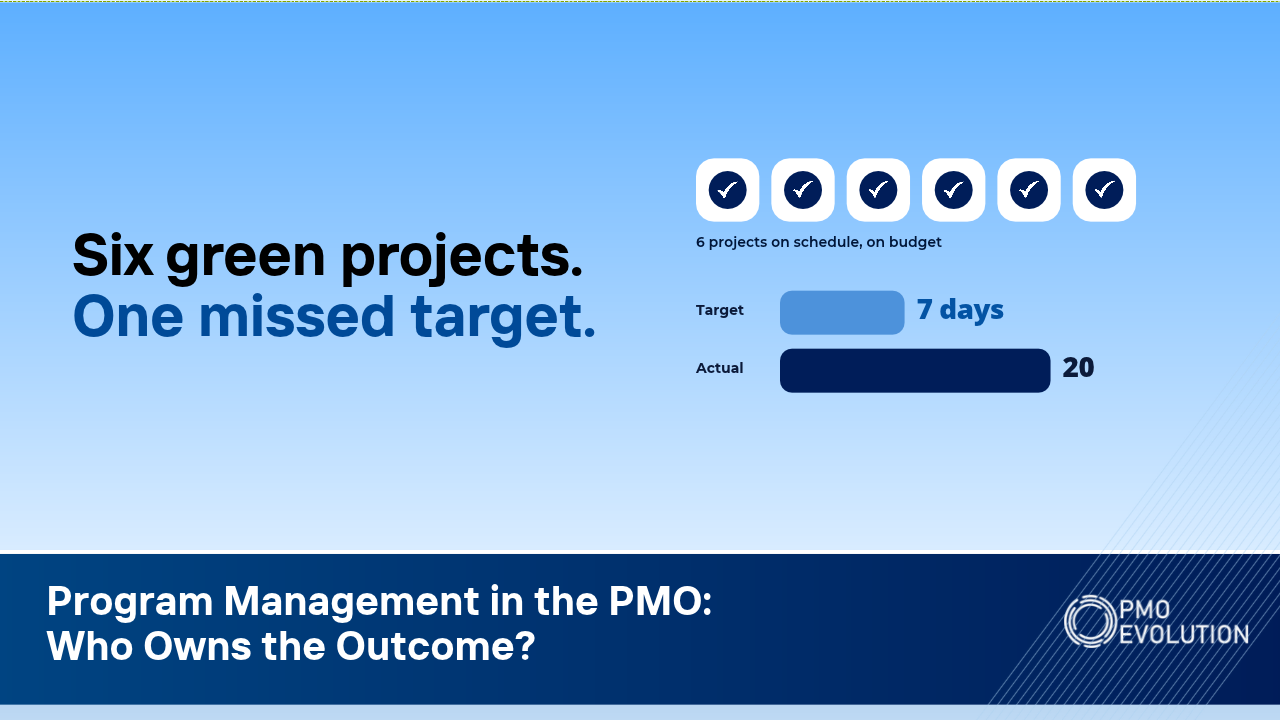
A status review answers one question: how is each initiative tracking against its plan? You look at schedule, cost, scope, risks, maybe resources. If everything is green, you move on. If something is red, you escalate.
That is useful work. It is also incomplete.
A mid-year reset answers a much harder question: should each of these initiatives still be in the portfolio? Strategy moves. Markets shift. The CEO who set priorities in January may have learned something in February that changed the math. The competitor that dictated half your roadmap may have just been acquired. The benefit assumptions that justified the funding may no longer be true.
A status review tells you whether you’re executing the plan well. A reset tells you whether you should still be executing the plan at all.
In the Vision2Value Framework, this work lives at the Benefits Realization and Sustainment layer. It’s the layer most PMOs underinvest in, partly because it’s uncomfortable. Killing or pausing initiatives feels like admitting failure. It isn’t. It’s the highest form of portfolio discipline.
Three questions that drive a real mid-year reset
When I run a portfolio reset with a PMO leader, we work through three questions for every active initiative. They sound simple. They are not. The honest answers tend to surface things nobody wanted to talk about.
The first question is about strategic fit. If we were starting from scratch today, knowing what we now know about the market, our customers, and our competitive position, would we still fund this initiative at this priority level? Be ruthless. The fact that it is already started is not a reason to keep going.
Why May is the right month for this work
Most companies are now closing or have just closed Q1. Boards are starting to ask hard questions about full-year plans. Executive teams are still close enough to their annual planning cycle that revisions are politically possible. Wait until August and you’re stuck. The narrative for the year is locked in, mid-year reviews have already happened, and changing course feels like a confession.
Get ahead of it now and you give your executive team time to make calm, data-informed adjustments instead of panicked Q4 cuts. That is the kind of work that builds PMO credibility for the long haul.
The second question is about benefits assumptions. When this initiative was approved, what did we promise the executive team it would deliver? Are those assumptions still credible? If the original case said “this will reduce customer churn by 15 percent,” is that still the bet we’re making? Sometimes the answer is yes and the case is even stronger. Sometimes the answer is no and nobody has bothered to update the executive narrative.
The third question is about cost of continuation versus cost of stopping. Sunk cost is not a reason to keep spending. The right comparison is forward cost to finish versus value left to capture. If you’ve spent $1.2M and the remaining $400K will deliver benefits worth $300K, you should stop. The $1.2M is gone either way. You’re choosing whether to throw $400K behind it.
That last question is the one that most often catches PMO leaders off guard. We’re wired to count what we’ve already invested. The discipline of looking only at the forward decision takes practice.
The practical playbook
Block four hours on your calendar this week. Pull every active initiative in your portfolio into a single working document. I do this in Smartsheet because the metadata I need (sponsor, original benefit case, current status, quarterly burn rate) is already there, and the conditional formatting helps the patterns jump out. Use whatever tool gets you there. The discipline matters more than the platform.
For each initiative, capture three columns: original benefit case in one sentence, current strategic priority it ladders up to, and your honest gut read on whether the original assumptions still hold. Yes, gut read. You can validate later. Right now you’re scanning for signal.
You’ll probably find three categories. Initiatives that clearly still belong in the portfolio. Initiatives that are obvious pause-or-kill candidates. And the awkward middle group where you genuinely don’t know. That middle group is where the next two weeks of work lives.
Schedule fifteen-minute conversations with the sponsors of every initiative in the awkward middle. Not status meetings. Resetting conversations. Bring the original benefit case and ask, “If I told you we could redirect this team to a different priority next month, what would you do?” Their answer tells you everything you need to know.
By the end of May, you should have a recommendation for your executive team. Initiatives to continue, initiatives to pause, initiatives to formally close. Be specific about what each decision would free up, in dollars and in people.
What this builds over time
The first time you do this, it will be uncomfortable. Sponsors will push back. Some executives will be defensive. That is normal.
Do it three quarters in a row and something changes. Sponsors stop bringing initiatives forward unless the benefit case is real, because they know the PMO will eventually come asking. Executives start to trust your portfolio recommendations because they’ve seen you walk away from things, not just add them. The work shifts from “the PMO tracks our projects” to “the PMO helps us spend our scarce capacity well.”
That’s what the Benefits Realization and Sustainment layer of Vision2Value is supposed to do. It’s also what most PMOs never quite get to, because it’s easier to add a new dashboard than to have a hard conversation with a sponsor.
If you’ve been running quarterly status reviews and calling that portfolio governance, this is the month to do something different. Block the four hours. Run the reset. The credibility you’ll build is worth far more than any new template.
If you’d like to walk through how to structure your mid-year reset for your specific portfolio, I’m happy to share what’s worked for the PMO leaders I’ve coached through this. You can grab time at https://calendly.com/pmoevolution.