
The register that remembered everything and changed nothing
A few years ago, during a portfolio assessment, a PMO director walked me through his lessons learned register with real pride. Four years of entries. Categorized, dated, searchable. One of the cleanest repositories I had seen.
I typed one word into the search bar: vendor.
The same vendor onboarding delay appeared in year one. And year two. And year three. Each time it surfaced mid-project, it cost the schedule roughly six weeks, and each time the team carefully wrote it up at close-out and filed it. The register had a perfect memory. The portfolio had learned nothing.
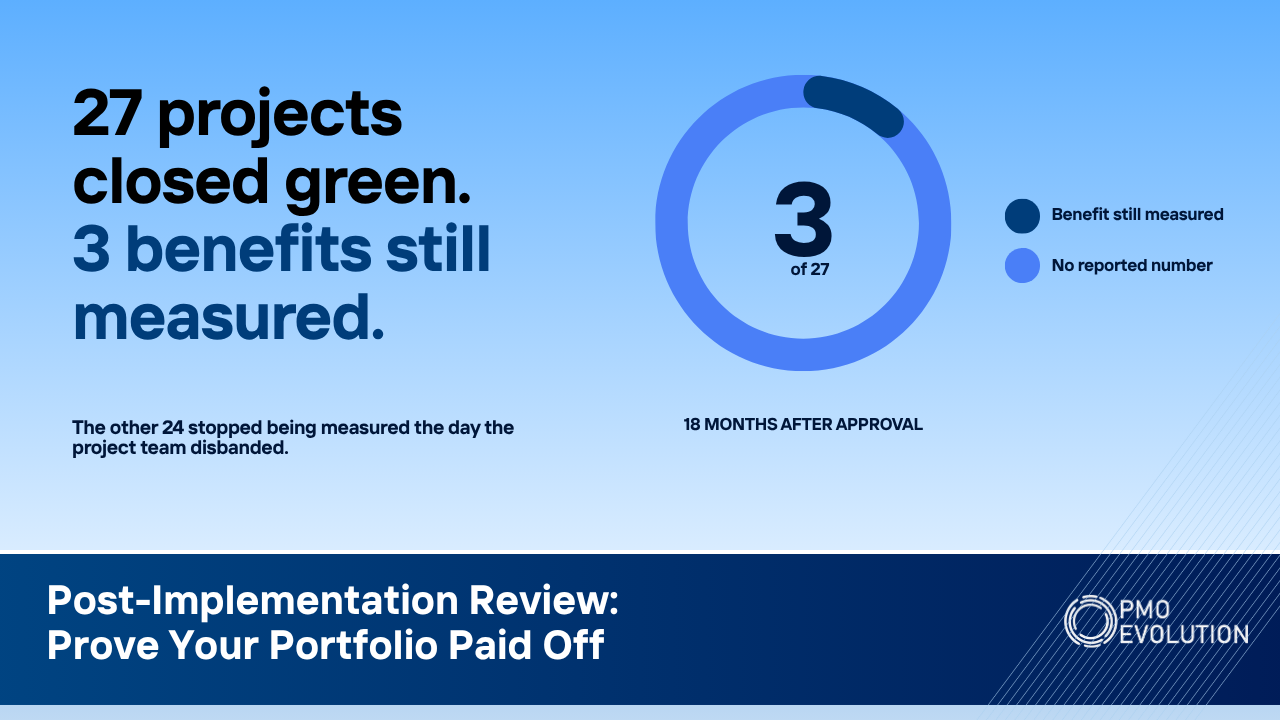
That engagement changed how I treat lessons learned. The problem was never capturing. PMOs are good at capture. The problem is that a lesson with no owner, no destination, and no deadline is not a lesson. It is a memory. And memories do not change roadmaps.
Why do lessons learned never change anything?
When I ask PMO leaders this question, the answers cluster around four failure points.
First, lessons are written as history instead of as proposals. "Vendor onboarding took longer than planned" describes the past. It asks nothing of anyone. Nobody has to accept it, reject it, fund it, or schedule it.
Second, lessons have nowhere to go. A project has a plan. A risk has a register with owners and responses. A lesson has a document. There is no pipe connecting that document to the portfolio roadmap, the estimating standards, or the templates the next project will inherit.
Third, timing works against you. Retrospectives happen at close-out, when the team is already mentally on the next assignment and the sponsor has stopped attending. The moment of maximum insight is the moment of minimum attention.
Fourth, nobody is accountable for the fix. The PM who wrote the lesson moves on. The PMO files it. Six months later a different PM hits the same wall, and the cycle produces another well-written entry.
There is a fifth factor that makes the other four survivable year after year: the cost of not learning never appears anywhere. A repeated vendor delay shows up as a schedule variance on some project, an estimate model that misses by 20 percent every cycle shows up as a string of individual overruns. No report adds those up and presents them as one number labeled "price of lessons we captured and ignored." If that number existed, someone would own it by Friday. Because it does not, the learning gap competes for attention against fully priced problems, and loses every time.
Mid-year is exactly the right time to break this cycle. You have six months of fresh evidence and six months of roadmap still open to change. That window closes when commitments lock.
Five steps to feed lessons into your roadmap
1. Write every lesson as a proposed change. Ban past-tense-only entries. "Vendor onboarding took six weeks longer than planned" becomes "Add a four-week vendor onboarding buffer to every estimate involving a new vendor, and start security review at contract signature." The first is a complaint. The second is a decision waiting for a yes or a no.
2. Route each lesson to one of three destinations within a week. Destination one: the portfolio roadmap, as a funded improvement item. Destination two: a standard, template, or checklist that every future project inherits. Destination three: closed, with a written reason. Those are the only three options. The moment you allow a fourth pile called "captured," everything ends up in it.
3. Give every accepted lesson an owner and a due date. Not the PMO as a group. One name, one date, visible in the same place your other portfolio work lives. If a lesson is worth accepting, it is worth tracking like work, because it is work.
4. Run a pattern review before planning locks. Pull every lesson from the last six months and sort by category, not by project. Single events make interesting stories. Patterns justify roadmap changes. Three different projects reporting estimate pressure in the same delivery stage is not three lessons, it is one systemic finding with three pieces of evidence. Bring the top three patterns, with their cost, to your planning session.
5. Show the executive team what changed. Once a quarter, present three lessons, what each one cost, and what the portfolio changed as a result. This is the step most PMOs skip and the one that builds the most credibility. Executives do not expect a portfolio without mistakes. They expect a portfolio that does not pay for the same mistake twice.
What changes when the loop closes
The first effect is financial and it arrives fast. Repeats stop. The client with the vendor onboarding delay recovered roughly six weeks of schedule in the first year after the fix, on that one lesson alone. Most registers I assess hold three to five repeat offenders of similar size, already documented, already paid for, waiting for a destination.
The second effect is slower and worth more. Your estimates start improving, because pattern findings feed the estimating standards instead of dying in project folders. Your intake sharpens, because the criteria inherit what underdelivered last cycle. And your standing with executives changes, because a PMO that can say "this mistake cost us six weeks last year, here is the fix already running" is speaking the only language that builds durable credibility: money, evidence, and change.
Where Smartsheet makes this real
You can run this on any platform, but here is how I build it for clients. A lessons register sheet with the proposed-change wording, category, cost estimate, destination, owner, and due date as columns. An intake form that triggers automatically at stage gates and close-out, so capture does not depend on anyone remembering. An automation that assigns the owner and starts date reminders the moment a destination is chosen. A report grouping lessons by category across the whole portfolio, which is what makes the pattern review a twenty-minute exercise instead of a two-day archaeology dig. And where clients run Control Center, accepted template fixes roll into the blueprint, so every newly provisioned project inherits the lesson on day one. That last part is the difference between learning and institutionalizing.
Your one action for next week
Open your lessons learned register and search for a repeat. One lesson that appears in more than one project. Rewrite it as a proposed change, take it to your next portfolio review, and get it a destination, an owner, and a date. One repeated lesson, converted to a roadmap item, will teach your organization more about the value of your PMO than the entire archive behind it.
This is the discipline my Vision2Value Framework builds in Layer 3, where benefits realization and lessons learned feed back into the portfolio roadmap instead of dead-ending in a folder. If you want to see where your own learning loop breaks, the PMO Value Blueprint is a three-to-eight week engagement that maps it end to end. No sales pitch, only a 30-minute conversation to start: https://www.pmoevolution.com/contact
NEXT LIVE SESSION
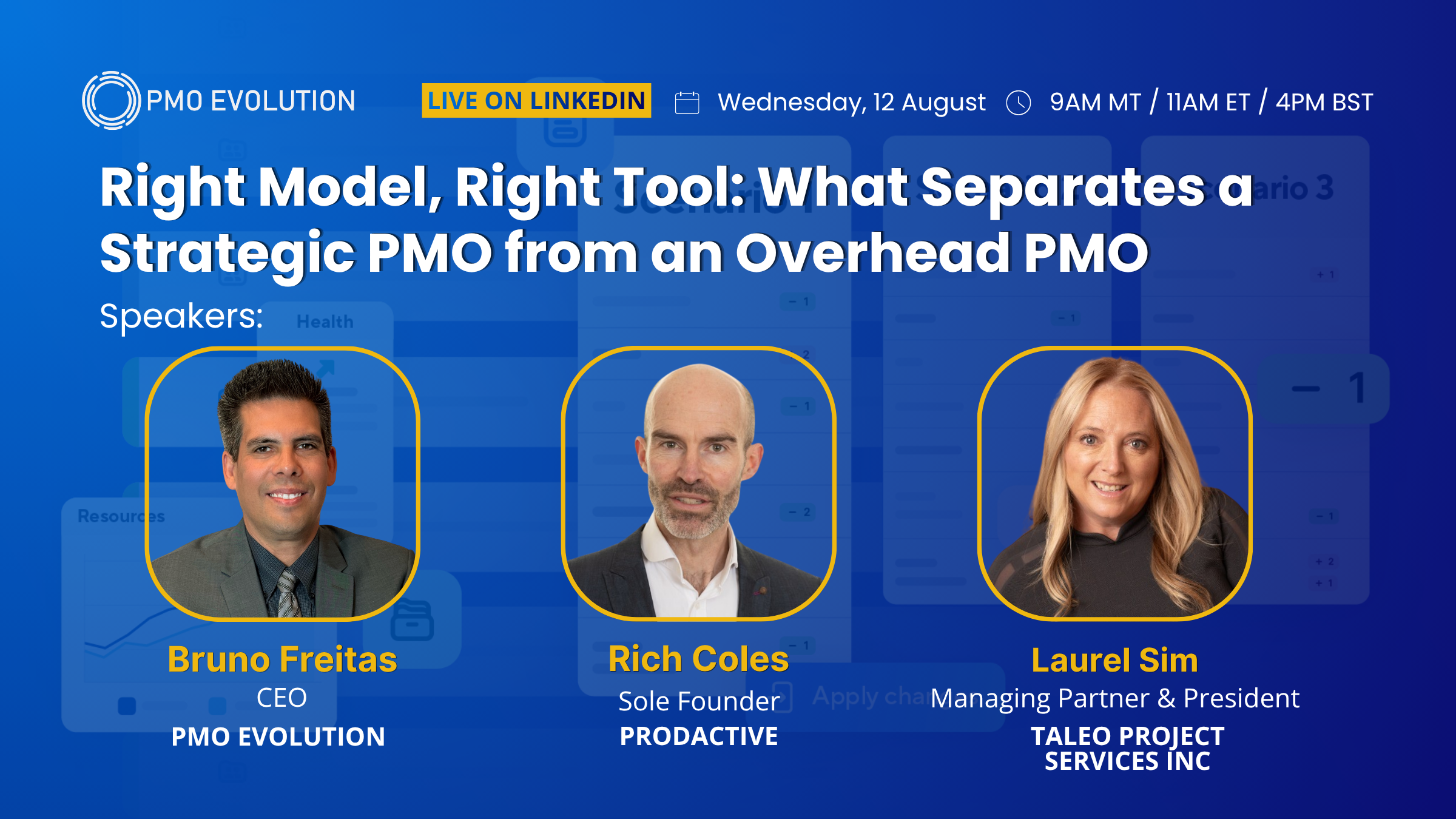
Right Model, Right Tool: What Separates a Strategic PMO from an Overhead PMO
Live on LinkedIn, Wednesday, August 12 at 9AM MT / 11AM ET / 4PM BST
I'm bringing together two people who have built and fixed PMOs from very different vantage points: Rich Coles, Sole Founder of Prodactive, and Laurel Sim, Managing Partner and President of Taleo Project Services Inc. Together we'll unpack what separates a strategic PMO from an administrative one, why the operating model has to come before the tool decision, and where Smartsheet honestly fits against other PPM solutions. If you're evaluating your next PPM investment, this session will help you make that call with clear eyes.