
Here's a stat that should keep every PMO leader up at night: 97% of portfolio management professionals say they're experimenting with AI. But fewer than half feel comfortable letting it operate without someone looking over its shoulder.
Read that again. Nearly everyone is trying AI. Almost nobody trusts it.
That gap between experimentation and confidence is where most PMOs are stuck right now. And if you don't close it deliberately, you're going to end up in one of two bad places: either you'll avoid AI entirely and watch your PMO become irrelevant, or you'll adopt it recklessly and make decisions based on outputs nobody validated.
Why the Gap Exists
I've been working with PMO leaders across multiple industries this year, and the pattern is consistent. The AI confidence gap isn't really about the technology. It's about three things: data quality, change management, and governance.
Data quality comes first. Only about 14% of IT leaders say they're confident their data is properly governed for AI. Think about what that means for your PMO. If your project data is inconsistent, your resource allocations are outdated, and your risk logs are stale, any AI tool you layer on top of that data is going to produce outputs that look polished but are fundamentally unreliable. Garbage in, confident-sounding garbage out.
Change management is the second issue. Most organizations are rolling out AI tools without investing in the human side of adoption. Project managers are being told to "use the AI features" without understanding when to trust the output and when to question it. There's no framework for how AI fits into existing workflows. It's just another tool dropped on people's desks.
Governance is the third piece. Who decides which AI recommendations get acted on? What's the escalation path when AI suggests killing a project that a business unit is emotionally attached to? Most PMOs haven't thought through these questions, and that's a problem because AI without governance is just automation without accountability.
What Smart PMO Leaders Are Doing Differently
The PMO leaders who are getting ahead of this aren't trying to become AI experts. They're building the conditions that make AI actually useful. Here's what that looks like in practice.
They're investing in data foundations before AI features. This means getting serious about how project data is captured, validated, and maintained. In our work with clients using Smartsheet, this starts with standardizing project intake and status reporting through Control Center templates. When every project follows the same structure and data standards, you've got a foundation that AI can actually work with. This is Portfolio Delivery in the Vision2Value Framework, and it's never been more important.
They're building AI governance into their existing PMO governance model. Instead of creating a separate "AI strategy," they're adding AI decision rules to their current portfolio governance cadence. For example: AI-generated risk assessments get reviewed in the weekly portfolio review. AI resource recommendations require PM validation before action. AI-suggested project prioritization changes go through the same approval process as any other portfolio change.
They're focusing on context engineering, not just prompt engineering. This is a concept that's gaining traction fast, and for good reason. Writing better prompts is table stakes. The real advantage comes from designing AI environments that are connected to your actual portfolio context: your strategic objectives, your resource constraints, your risk tolerance, your delivery track record. When AI has that context, its outputs shift from generic to genuinely useful.
A Practical Starting Point
If you're not sure where to start, here's a four-step approach I've been recommending to clients.
Step 1: Audit your data readiness. Pick your top ten projects and score them on data completeness. Are statuses current? Are resource allocations accurate? Are risks and dependencies documented? This gives you a baseline and usually reveals how much foundational work needs to happen.
Step 2: Identify one high-value AI use case. Don't try to boil the ocean. Pick one area where AI could save significant time or improve decision quality. Portfolio risk assessment is usually a good starting point because the data requirements are clear and the value is obvious to executives.
Step 3: Build the governance guardrails. Before you turn anything on, define who reviews AI outputs, how they get validated, and what happens when AI and human judgment disagree. Write this down. Put it in your PMO playbook.
Step 4: Run a controlled pilot. Test your chosen use case with a subset of the portfolio. Compare AI-assisted decisions against traditional approaches. Measure the delta. Use the results to build confidence and make the case for broader adoption.
The PMO's Moment
Here's what excites me about this moment: PMOs are uniquely positioned to lead AI adoption in their organizations. We sit at the intersection of strategy and execution. We own the data. We manage the governance frameworks. We understand how decisions flow through the organization.
But that positioning only matters if we act on it. The PMOs that close the AI confidence gap in 2026 won't just survive. They'll become indispensable strategic partners. The ones that wait will watch other functions take the lead and wonder what happened.
If you're a PMO leader reading this, my challenge to you is simple: don't let perfect be the enemy of good. You don't need perfect data or a perfect AI strategy. You need a starting point, a governance framework, and the willingness to learn as you go. That's always been the PMO way. This is just the next evolution.
🌐 Visit our website: pmoevolution.com
🔔 Follow us on LinkedIn: PMO Evolution
👉 Subscribe on YouTube: PMO Evolution
📅 Coming Up: Live Webinars You Don't Want to Miss
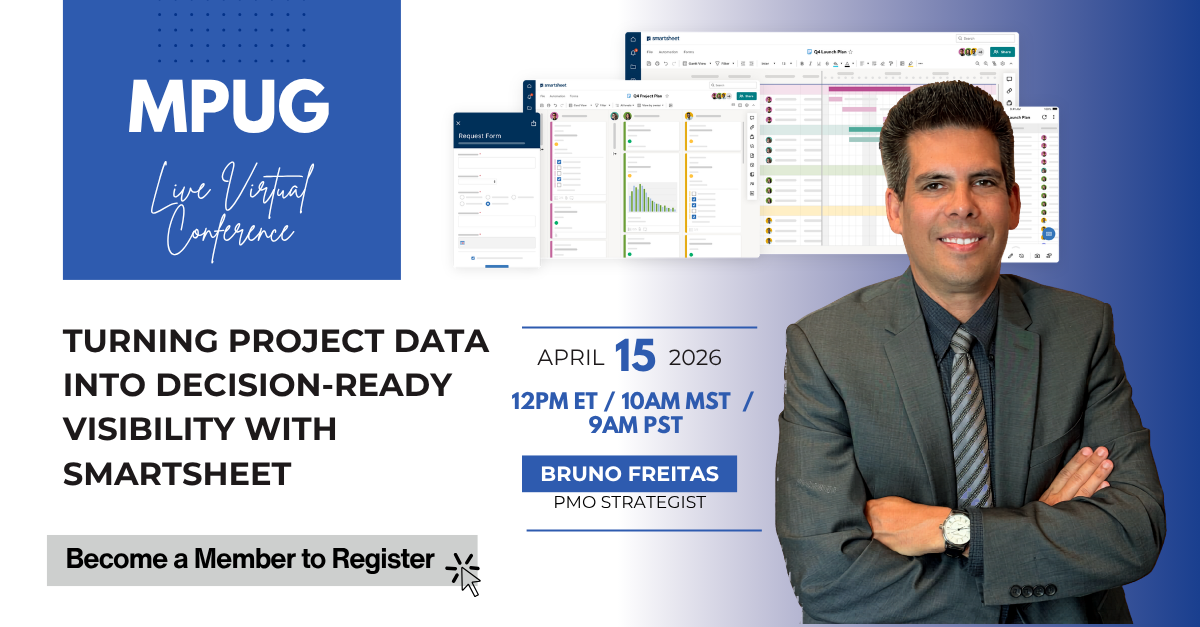
Turning Project Data Into Decision-Ready Visibility with Smartsheet
Wednesday, April 15 | 12–1 PM ET / Hosted by MPUG
If your PMO is generating data but leadership still can't make clear decisions from it — this webinar is built for that problem. I'll be going live with MPUG to show how Smartsheet can work as a decision-ready visibility platform, covering sheets, forms, automations, reports, and dashboards in a working live demo.
🔗 Register here → https://mpug.com/events/turning-project-data-into-decision-ready-visibility-with-smartsheet
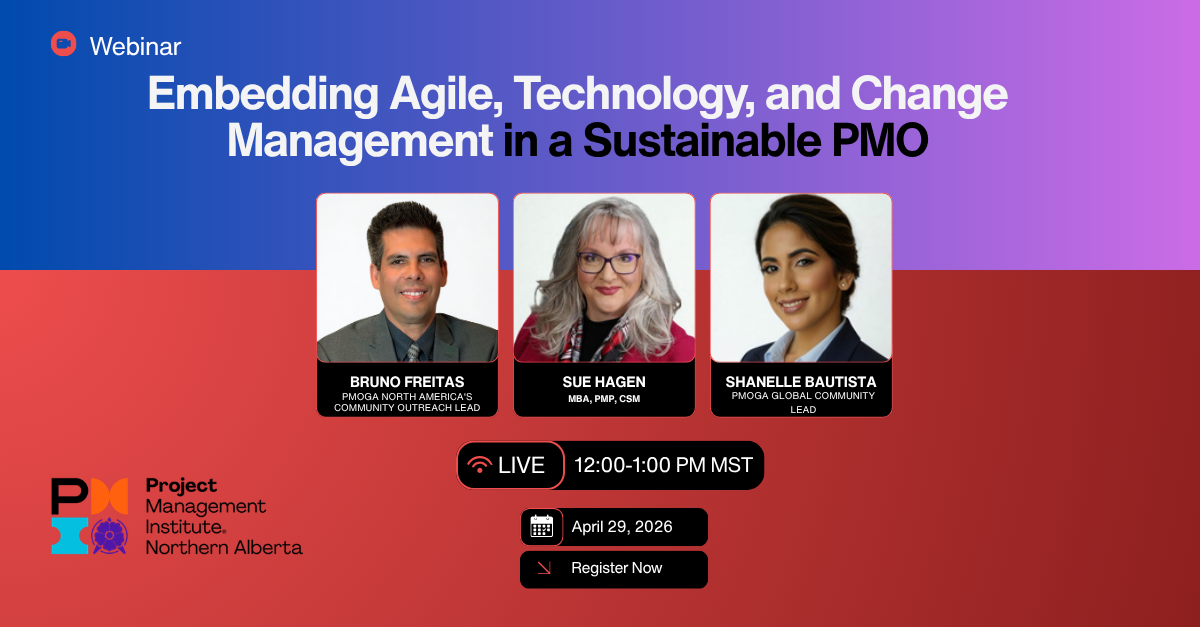
Embedding Agile, Technology, and Change Management in a Sustainable PMO
Wednesday, April 29 | 12–1 PM ET | Hosted by PMI Northern Alberta Chapter
This one is a panel conversation — and a free one. I'll be joining Sue Hagen and Shanelle Bautista to talk about what it actually takes to build a PMO that stays relevant. We're covering Agile adoption, technology enablement, change management as a discipline, and what sustainable PMO performance looks like in practice.
🔗 Register here → https://pminac.com/component/eventbooking/embedding-agile-technology-and-change-management-in-a-sustainable-pmo