
If there’s one pattern I see over and over inside enterprise PMOs, it’s the quiet disconnect between how fast work moves and how slowly organizations make sense of it. Teams are busy, tools are full, updates fly across channels, but when the quarter ends, the same uneasy question comes back from leadership:
“Are we investing in the right work, and is any of this actually creating the value we predicted?”
Most PMOs hesitate at that moment. Not because people aren’t working hard, nor because leaders don’t care, but because the environment surrounding the work has become disorganized. One group keeps everything in spreadsheets. Another logs their world in a myriad of tools. A third manages projects in standalone files that never quite line up with anything else. By the time all of this is stitched together for executive reporting, the story is already outdated, softened, or debated into something that feels more political than factual.
A modern PMO can’t function in that kind of fragmentation, not if it wants to be credible, influential, and part of honest strategic conversations.
And this is where Smartsheet shifts from being just another tool to becoming something more.
It becomes a unifying layer, an operating backbone that pulls execution, governance, and value realization into a system that actually breathes with the business.
How Smartsheet Consolidates Project, Portfolio & Reporting Functions
Most PMOs don’t suffer from a lack of data; they suffer from data living in too many places, updated at different times, in different formats, with different interpretations. That fragmentation creates unnecessary friction: manual consolidation, inconsistent reporting, conflicting status narratives, and delays in decision-making.
Smartsheet addresses that, not by replacing every tool, but by anchoring the portfolio layer in one environment.
When implemented correctly, three things happen:
- Work and reporting operate from the same data source.
Updates aren’t copied into PowerPoint, emailed, or manually interpreted. Updates flow upward automatically. Leadership sees the same truth teams operate from. - Governance becomes embedded not external.
Instead of governance living in slide templates, audits, or checklists, Smartsheet enforces it: stage gates, approvals, decision logs, change impacts, benefit forecasts, and risk triggers are built into the workflow itself. - Strategy becomes traceable.
Initiatives can be linked back to enterprise priorities, capacity planning decisions, and benefit commitments not just timelines or progress bars.
This is why Smartsheet works at scale: not because it’s “easy” or “simple,” but because it gives the PMO control of the ecosystem without forcing every team into a rigid methodology. The flexibility sits at the execution layer — the discipline sits at the portfolio layer.
Smartsheet doesn’t create maturity. It enables it, if the PMO leads with intention.
Integrating Vision2Value Governance Templates into Smartsheet
This is where organizations either succeed or get stuck. A tool alone doesn’t shift a PMO from activity reporting to value reporting, structure does. The Vision2Value™ framework provides that structure by redefining how work enters the system, how it progresses, and how value is measured.
When Vision2Value™ is embedded into Smartsheet, the portfolio ecosystem changes in three ways:
- Intake becomes strategic alignment, not request processing.
Requests aren’t “submitted.” They are evaluated against strategic intent, capacity constraints, expected benefits, and risk appetite. The outcome isn’t a list; it’s a portfolio shaped around business outcomes. - Execution becomes value-managed, not milestone-managed.
Teams still deliver tasks and timelines but the PMO tracks benefit forecasts, value leakage, dependency impact, stabilization time, and operational adoption. Progress is no longer defined by “percent complete” but by how close the initiative is to delivering its intended business outcome. - Reporting shifts from status updates to decision intelligence.
Executives don’t get commentary. They get clarity:
- What’s delivering value?
- What’s drifting?
- What needs escalation or trade-off?
- What should stop?
At that point, Smartsheet isn’t a project tool, it’s the execution layer of a value realization system. And the PMO stops behaving like an administrative function and starts operating like a strategy partner.
The Business Case: How Automation Frees Time for Strategic Work
Automation is often talked about as a time-saver, but in a PMO it does something more important- it shifts how the team uses its time.
Before automation, PMO work is dominated by follow-ups, reconciliations, reminders, escalations, and formatting. Leaders know this intuitively; that's why so much PMO effort feels reactive. But when Smartsheet automates status reminders, approval routing, health score updates, dashboard refreshes, and risk escalations, the PMO regains the space to focus on strategic responsibilities.
This is where the real business case emerges:
- The PMO starts analyzing data instead of collecting it.
- Risks are managed proactively instead of being discovered too late.
- Prioritization conversations become evidence-based, reducing politics.
- Leaders receive timely portfolio insights without waiting for the monthly cycle.
- Teams align faster because the system aligns them automatically.
Most PMO leaders underestimate how much strategic capacity is hidden inside manual work. Automation doesn’t just create efficiency it restores the PMO’s intended purpose.
The organization doesn’t invest in a PMO to chase updates. It invests in a PMO to enable clarity, prioritization, and outcomes. Automation is what makes that possible at scale.
A Modern PMO Requires a Connected Ecosystem, Not More Tools
If your PMO is working hard but struggling to demonstrate impact, you don’t have a capability problem; you have a system problem. The PMO of the future isn’t defined by documentation, templates, or methodology maturity. It’s defined by its ability to connect strategy to execution and execution to measurable value.
Smartsheet, when aligned with Vision2Value™, gives you that backbone.
If you’re evaluating how to modernize your PMO and want to understand what this ecosystem could look like inside your organization, I’d be happy to walk you through a configuration built for portfolio-level leadership.
If you’d like to see how a connected Smartsheet ecosystem could look for your PMO, I’m happy to walk you through it in a way that reflects your reality not a generic software demo.
👉 Book a walkthrough or reach me here:
https://www.pmoevolution.com/contact
Join Me for an Upcoming Webinar on December 17!
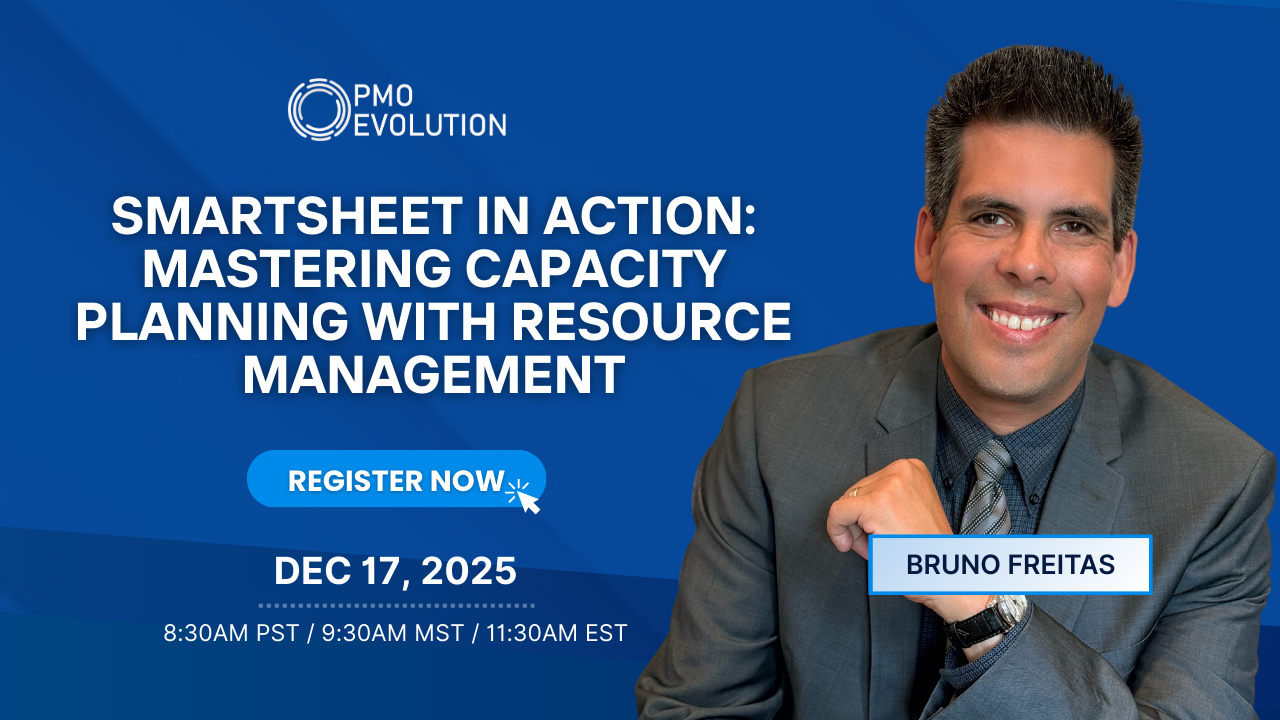
In this hands-on session, we’ll show exactly how Smartsheet Resource Management gives PMOs control over one of the toughest parts of our role: understanding who’s available, when, and for what.
You’ll learn how to:
✅ Build a real-time view of project demand versus team capacity
✅ Forecast workload and spot bottlenecks before they slow delivery
✅Track resource utilization with automated dashboards
✅ Align capacity planning with your PMO’s strategic priorities
We’ll walk through a live demonstration of the exact approach PMO Evolution uses to build capacity planning solutions in Smartsheet — turning processes that used to take hours into insights available in seconds.
This session is especially valuable for PMO leaders, portfolio managers, and delivery teams who want a clearer picture of their people, priorities, and performance.
Register here: https://events.teams.microsoft.com/event/47296656-5f2d-4225-913a-a16e03b29a0e@7c439afc-5c44-4af2-b6b8-0f148e2ab40a