
Most leadership teams are not short on strategy.
They are clear on where the organization wants to go. They have vision decks. The language is familiar and usually coherent.
Growth. Focus. Transformation. Value. From square one, it looks aligned.
Later on, PMO leaders often see other branches forming.
Uncertainty about consequences starts.
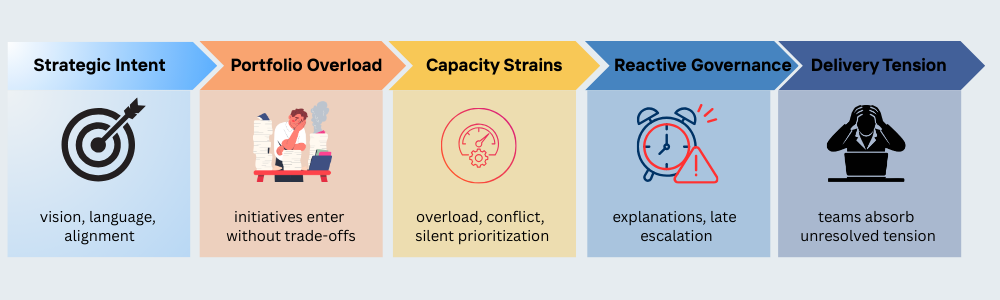
The strategy may be known, but its impact on funding decisions, capacity allocation, and governance behavior remains inconsistent. Work continues to accumulate. Trade-offs remain implicit. And delivery teams are left to absorb tension that was never resolved upstream.
Too many initiatives in flight.
Resources stretched thin across competing priorities.
Not between vision and execution in theory, but between agreement and consequence in practice.
While portfolio strategy is easy to articulate, portfolio clarity is rare, and more challenging to sustain.
Why Strategy Survives Discussion But Struggles With Delivery
At the executive level, strategy must remain abstract. That abstraction is not a flaw, it is necessary.
But abstraction has a side effect.
It delays commitment.
As long as priorities are not expressed through funding decisions, capacity limits, and delivery sequencing, strategy remains aspirational. Agreement is easy because nothing tangible has been given up yet.
The friction starts when strategy meets reality:
- Finite capacity
- Overlapping mandates
- Political sponsorship
- Sunk costs
- Delivery teams already operating at their limits
Strategy stops being a statement and becomes a series of choices.
What gets funded now.
What gets delayed.
What gets protected even when delivery is hard.
And what quietly continues because no one wants to own the stop decision.
Most organizations don’t struggle to define priorities. They struggle to operationalize prioritization when everything sounds important and the cost of saying no is visible.
This is where strategy might weaken and snap, not because leaders lack intent, but because the portfolio layer isn’t doing its job.
Over time, strategy does not fail dramatically. It gets diluted by accumulation. What if it is rather challenged by debate?
Without questioning the strategy itself, PMOs struggle with how little it seems to shape day-to-day decisions.
Strategy only creates value when it is forced to make choices
The problem is not that strategy is wrong. It’s that strategy, on its own, doesn’t decide anything.
Value begins to form only when strategy is embedded into the structures that govern how work is actually defined, funded, and sequenced. Without portfolio structures that translate intent into commitments, governance mechanisms that surface real trade-offs, and tools that make constraints visible early, strategy remains aspirational—well understood, widely referenced, and largely unenforced.
This is where portfolio clarity matters.
Portfolio clarity is not about better reporting or cleaner alignment slides. It is about turning intent into consequence. It makes priorities visible not just in theory, but in how money is allocated, how capacity is consumed, and how decisions are made when everything cannot move at once. It forces leadership teams to confront what is protected, what is optional, and what must wait before delivery pressure removes the choice altogether.
This is also where the role of the PMO fundamentally shifts.
PMOs stop translating strategy after the fact and start operationalizing it in real time. Not by declaring priorities, but by shaping the conditions under which priorities are revealed. By influencing what gets funded, what is sequenced later, what accelerates when conditions change, and what quietly stops because it no longer justifies the trade-off.
Technology plays a supporting role here not as a solution, but as an enabler of clarity. Tools like Smartsheet do not create good judgment or resolve competing interests. What they do is make clarity sustainable. They connect objectives to initiatives, expose capacity tensions early, and anchor governance conversations in shared, current truth rather than retrospective explanation. When used well, they reduce the distance between strategy and consequence and make it harder for difficult decisions to be postponed under the guise of alignment.
Portfolio clarity is where value is protected or lost
Portfolio clarity is not about visibility for visibility’s sake. It’s not about more reporting or cleaner dashboards.
It is about making trade-offs explicit before delivery pressure forces reactive decisions.
True portfolio clarity surfaces questions leaders often prefer to delay:
What are we actually committing capacity to?
Which initiatives are protected when constraints tighten?
Where are we intentionally overloading teams and why?
Which decisions are we postponing under the comfort of “monitoring”
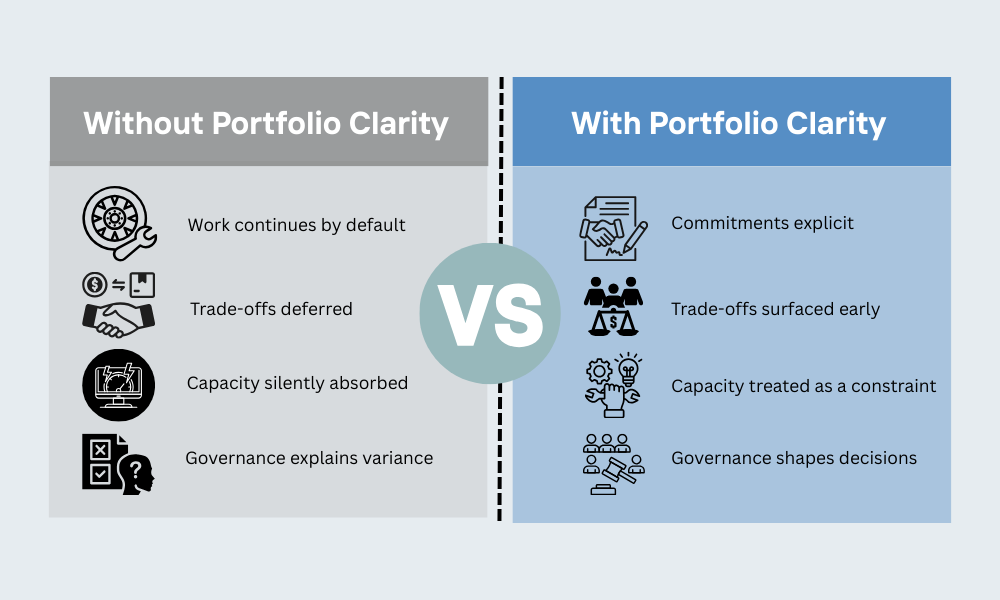
Without clarity, governance becomes defensive. Meetings focus on explaining variance, managing risk after the fact, and justifying decisions that were never consciously made. By the time issues surface, options are already constrained.
With clarity, the tone changes.
Governance becomes forward-looking.
Decisions are made earlier.
Confidence replaces control.
This is where PMO work stops being perceived as administrative and starts being experienced as strategic, not because the PMO claims that role, but because leaders feel the difference in decision quality.
Embedding strategy into how decisions are made
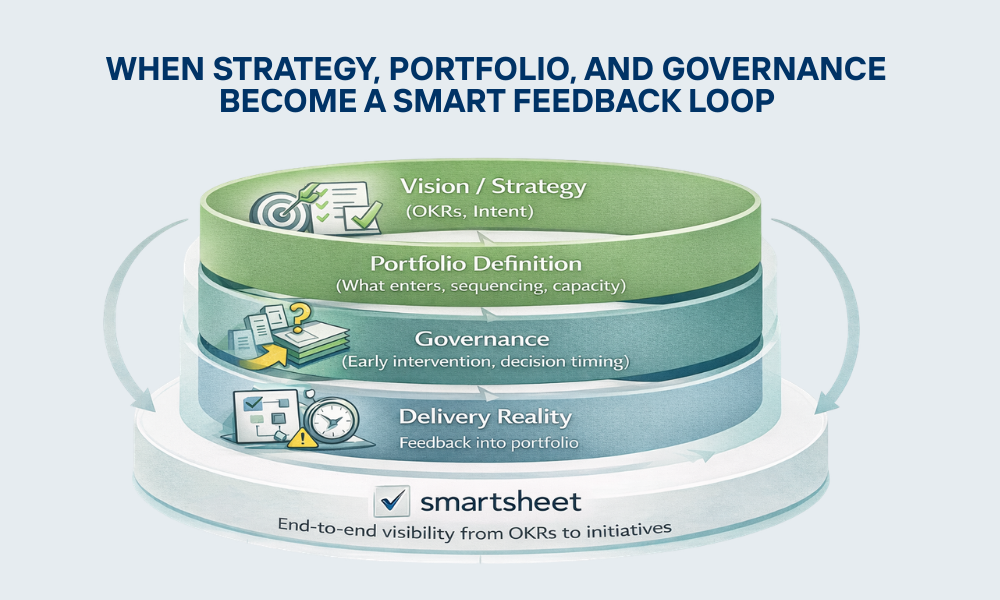
Embedding strategy must ensure that strategic intent shows up where real decisions are made: in what enters the portfolio, how work is sequenced against capacity, and how priorities are revisited when conditions change. When those mechanisms are disconnected, strategy weakens as it moves downstream.
When they are deliberately integrated, the dynamic changes.
Portfolio structures stop being passive containers and start enforcing choice. Governance shifts from reacting to delivery outcomes to shaping decisions early enough to matter. Tools move beyond reporting to sustaining clarity connecting objectives to initiatives and initiatives to execution reality in a way leaders can engage with continuously.
This is how vision becomes value.
Not because it guarantees perfect decisions, but because it makes trade-offs explicit and postponement harder to justify. Constraints surface earlier. Misalignment becomes visible while options still exist. And PMOs gain structural leverage to influence outcomes without needing to own authority.
Tools like Smartsheet matter here as enablers of that system. End-to-end visibility from OKRs to initiatives provides the connective tissue that allows strategy, portfolio definition, and governance to operate as one. It reduces decision latency, anchors governance in shared truth, and helps strategic intent hold under pressure.
For PMO leaders, this is the work.
Not translating strategy after delivery has absorbed the risk.
Not defending governance once momentum is lost.
But embedding intent into the structures that shape behavior before choices are made for you.
That is how strategy stops being cheap.
And how portfolio clarity becomes the source of value.
👉 Not subscribed yet? Join PMO Pulse for weekly insights.
https://www.pmoevolution.com/newsletters/pmo-pulse
👉 Or book time if you want help applying this now.
https://www.pmoevolution.com/contact