
|

Anyone who has spent time leading a PMO eventually becomes familiar with a certain look. It appears moments before a steering committee meeting, usually on the face of a project manager holding a spreadsheet that feels fragile or a slide deck updated a little too close to the deadline. It’s an expression somewhere between confidence and hope: a quiet wish that nothing unexpected will surface once the room starts asking questions.
I know that expression well. I’ve worn it myself.
Over the years, I’ve presented reports that were accurate when I created them but already outdated by the time I entered the boardroom. I’ve witnessed dashboards that looked polished yet depended on late-night manual updates and multiple rounds of reconciliation. And I’ve felt that brief moment of anxiety when someone points to a number and asks if I’m certain it’s correct.
In that moment, the issue is rarely the data itself. It is the credibility behind the data and once credibility erodes, the PMO’s strategic influence follows.
The Hidden Cost of Data Fragmentation
Across industries, PMOs are managing increasingly complex portfolios with tools that were never designed for that level of responsibility. Excel, standalone Microsoft Project files, SharePoint lists, and manually assembled PowerPoints continue to dominate daily work even in organizations that have long outgrown them.
It is not a technology problem. It is a friction problem.
People don’t avoid tools because they resist technology; they avoid tools that disrupt the way they work. When systems introduce friction, teams compensate by creating their own workarounds: duplicate schedules, offline RAID logs, private trackers, and parallel versions of the truth. Over time, this creates an environment where the official system is technically in place, but the real activity happens elsewhere.
The impact is cumulative:
- Data becomes stale faster than it can be refreshed.
- Reports diverge from what is actually happening.
- Project managers hesitate to maintain multiple sources of information.
- PMO leaders spend more time validating numbers than interpreting them.
- Executives begin to question the reliability of what they are shown.
A PMO can withstand many challenges; fragmented data is not one of them.
It drains trust, slows decision-making, and turns the PMO into a reporting function rather than a strategic partner.
When Reporting Becomes Fragile
Most PMO leaders eventually face a moment that exposes the fragility of their reporting process. It might be the night before a major steering committee meeting or during a quarterly portfolio review. One update, an adjusted milestone, a newly discovered dependency, an unexpected risk forces everything else to shift. Suddenly, the slide deck needs to be rebuilt, the numbers need verification, and the narrative needs to be rewritten.
The problem isn’t the change itself. Change is constant.
The problem is that the reporting structure cannot absorb the change.
It collapses under pressure because the data it relies on has traveled through too many spreadsheets, files, and manual touchpoints. The PMO becomes responsible for reconstructing the truth instead of revealing it.
This burden carried quietly by PMO leaders erodes confidence on both sides: the leader presenting the data and the executives receiving it. No amount of templates or stronger enforcement fixes this problem. The underlying issue is the lack of a reliable, unified information flow.
Why Traditional PPM Tools Fail to Deliver
Many organizations invest in PPM tools believing they will solve the reporting challenge. Yet adoption often fails, even with well-known platforms. The reason is remarkably consistent: these systems expect teams to adjust their behaviors to fit the tool.
When a platform adds steps, changes established habits, or forces unnatural workflows, project managers begin to work around it. Updates become inconsistent, data becomes unreliable, and dashboards lose relevance. Once adoption drops, the PMO is left maintaining two systems—the official one and the one people actually use.
A tool cannot fix a reporting problem if the team avoids using it.
Adoption is not created by enforcement; it is created by ease.
The tools that succeed are the ones that align with the way people already work—not the ones that attempt to redesign those behaviors from the outside.
A Turning Point: Systems That Reflect Real Work
For me, the shift came when I began designing portfolio environments in Smartsheet—not as a rigid replacement for existing tools, but as an extension of how project teams naturally work. Its spreadsheet-like design reduced friction. Its flexibility allowed us to build workflows that matched our governance model. And its automation capabilities helped eliminate the manual effort that kept data fragile.
Several changes happened quickly:
- Project managers updated schedules within the system because it felt familiar.
- Dashboards refreshed automatically without manual intervention.
- RAID logs fed executive views in real time.
- Forms allowed teams to contribute risks, issues, or decisions without needing to open a spreadsheet.
- Alerts and automations replaced reminder emails and follow-ups.
- Governance rules were embedded directly into the workflows
The system became the natural place to work rather than a system people needed to remember to update.
And when people consistently work in one system, the PMO finally gains something it rarely has: real-time, reliable data.
What Real Portfolio Visibility Looks Like
Once the data flow becomes stable, visibility improves at every level of the portfolio:

The value is not in the dashboards themselves; it is in the fact that the dashboards reliably reflect reality.
A Smarter Approach for PMO Leaders
A more effective data-to-decision workflow does not require a massive transformation. It requires clarity of purpose and a commitment to designing systems that support how people actually work. PMO leaders considering this shift can focus on a few guiding principles:
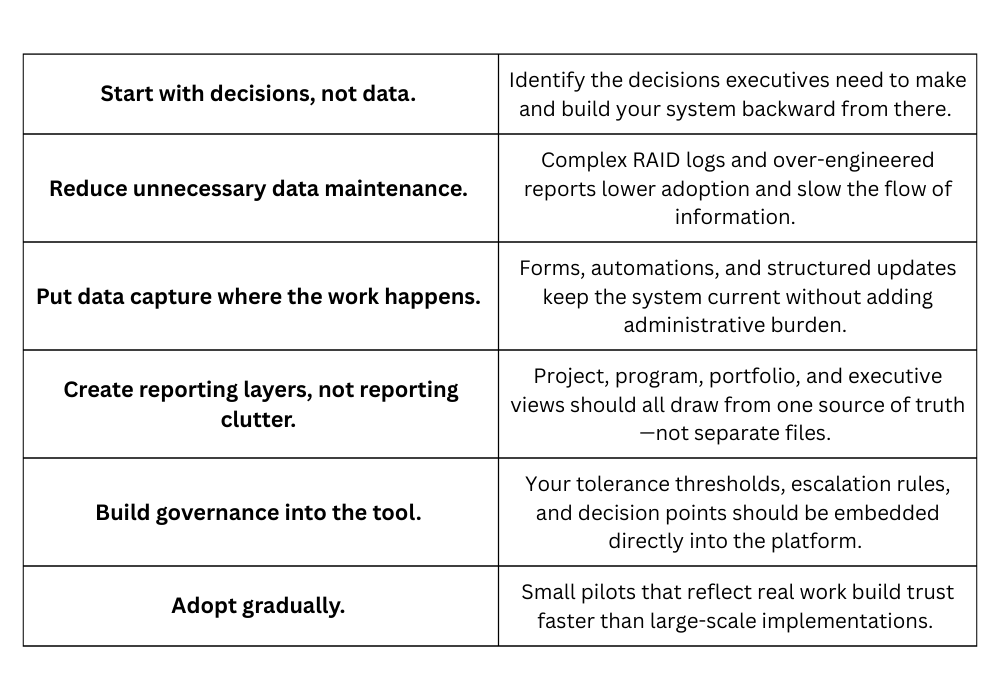
These practices are accessible to any PMO, regardless of size or maturity.
Why This Matters Now
Executives have less patience for manual reporting and more expectation of real-time insight. Traditional reporting cycles cannot keep pace with the speed of modern business. PMOs that rely on fragile data will find their influence diminished, while those operating with real-time visibility will become essential strategic partners.
When tools support the flow of work rather than interrupt it, everything improves:
decisions become faster, risks surface earlier, teams collaborate more effectively, and the PMO strengthens its credibility.
This is the shift from data collection to decision enablement, a shift every modern PMO must make.
If this feels familiar, you’re not alone. Every PMO leader reaches a point where unreliable data, fragile reporting, and fragmented tools begin to limit their influence. The good news is that this challenge is solvable with the right design approach and the right operating layer.
If you’re exploring how your PMO can strengthen decision-making through better systems and real-time visibility, I’d be glad to help.
👉 https://www.pmoevolution.com/contact
 |