
Most organizations don’t struggle with strategy because they lack ambition or intelligence. They struggle because strategy, once approved, is expected to somehow translate itself into thousands of everyday decisions without any real mechanism to guide those choices.
I’ve seen this pattern repeat itself across PMO leadership roles, regardless of industry or operating model. A strategy is announced with confidence and care, the narrative lands well, and for a moment it genuinely feels as though the organization is aligned around a common direction. But once the initial momentum fades, delivery quietly settles back into familiar patterns. The same initiatives continue to receive funding, teams remain overloaded, and the harder conversations about trade-offs are deferred rather than resolved.
Several months later, the frustration begins to surface. Executives start asking why the strategy hasn’t translated into visible results, delivery teams feel pulled in competing directions, and the PMO finds itself trying to explain a disconnect it neither created nor fully controls.
In my experience, this isn’t an execution problem. It’s what happens when strategy has no portfolio to carry it into action.
Why strategy documents don’t translate into results
Strategy documents are designed to articulate direction, not enforce behavior. They describe where the organization wants to go and what it wants to stand for, but they rarely specify what must change in the decisions people make every day as a result.
That gap becomes obvious the moment strategy leaves the boardroom and encounters operational reality.
What it typically runs into will feel familiar to most PMO leaders:
- Projects already in flight that no one feels empowered to stop.
- Budgets committed in prior cycles and protected more by politics than relevance.
- Leaders accountable for local objectives that quietly conflict with enterprise priorities.
- Teams already operating at or beyond capacity, with no obvious release valve.
None of this reflects bad intent. It reflects momentum. In the absence of a system that forces choices to change, delivery defaults to continuing what is already underway. Work progresses. Reports are produced. On the surface, things appear under control. Strategically, very little actually shifts. This is where organizations often misdiagnose the issue. They assume execution is weak, when in reality decision-making has never been rewired to reflect the strategy.
The role of the portfolio as the bridge between strategy and execution
A portfolio is often misunderstood as a list of projects, programs, and initiatives. When that’s the case, portfolio management becomes administrative by design; tracking, categorizing, reporting. Necessary work, but not strategic work.
A functioning portfolio plays a very different role. It is the place where strategic intent is translated into investment decisions that have real consequences. It’s where leaders are forced to confront trade-offs they would otherwise prefer to avoid. When the portfolio is doing its job, it makes certain questions unavoidable. If this initiative truly matters, what are we willing to delay or stop to make room for it? If priorities have shifted, why does our funding still look the same? If capacity is constrained, which outcomes are we actively choosing to protect?
Without a portfolio that can hold these conversations, strategy remains aspirational. It can be referenced, defended, even celebrated, without ever materially influencing how resources are allocated or how work is sequenced. This is also where the PMO’s role becomes pivotal. When the portfolio is treated as a reporting artifact, the PMO is seen as an administrative function. When the portfolio is treated as a decision system, the PMO becomes a strategic partner, sometimes uncomfortably so.
Defining portfolio intent: objectives, outcomes, and value
Most PMOs don’t get to design strategy from a blank slate. They inherit it, already approved, already socialized, and often already ambiguous in ways that only surface when decisions need to be made. For the portfolio to function as a bridge between strategy and execution, it needs intent that is usable, not inspirational. In practice, that intent rests on three interdependent elements.
First, there must be strategic objectives that actually shape decisions. Many strategies rely on broad themes or pillars that sound compelling but offer very little guidance when priorities collide. A portfolio-ready objective does something specific: it helps leaders choose between competing investments. If two initiatives are in conflict and the objective doesn’t clarify which one should win, it isn’t doing its job.
Second, the portfolio needs clarity on outcomes, not just activities. Without outcomes, portfolio conversations drift toward delivery mechanics—milestones, status, percent complete—while the actual change the organization is trying to create remains assumed. Over time, this erodes credibility, especially when significant investment produces little visible impact.
Third, there needs to be an explicit value logic. Not all value is financial, and not all value is immediate, but all value should be intentional. At the portfolio level, that means being clear about what kind of value is being pursued, when it is expected to materialize, and what trade-offs are being consciously accepted in the meantime.
When these elements are missing, the portfolio becomes a politically neutral space. Almost anything can be justified. Everything can be labeled as aligned. And strategy quietly loses its ability to influence behavior.
Common pitfalls when PMOs inherit vague or conflicting priorities
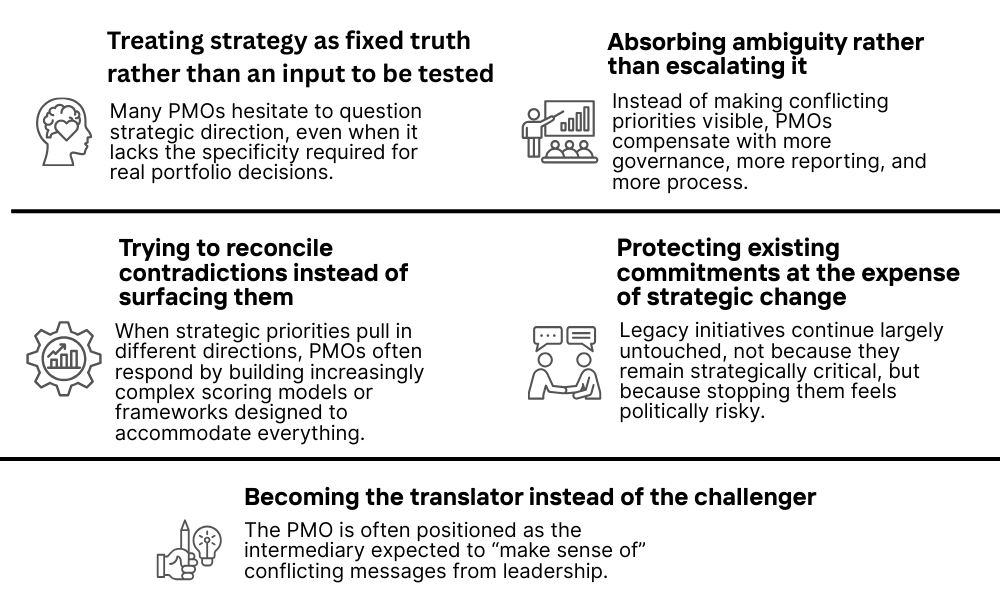
Most PMO leaders don’t struggle because they lack competence or credibility. They struggle because they are asked to operationalize strategies that were never fully resolved at the leadership level. When priorities conflict, or when ambition outpaces clarity, the PMO often becomes the place where that tension quietly lands.
What “good” looks like at this stage in Vision2Value 2.0
At this stage of Vision2Value 2.0, success isn’t defined by sophistication or maturity scores. It’s defined by whether strategy can meaningfully influence decisions.
A “good” portfolio at this point has a few clear characteristics:
- Strategy has been translated into a small set of decision-shaping statements that leaders actively use
- Demand is filtered against those statements, rather than automatically accepted and rationalized later
- Portfolio discussions focus on consequences and trade-offs, not just status updates
- Constraints are visible, acknowledged, and owned
This doesn’t eliminate tension. It changes the nature of it. Instead of tension showing up downstream as delivery pain, it shows up upstream as strategic choice. That’s where execution starts to reflect intent rather than inertia.
What PMO leaders can do right now
None of this requires a multi-year transformation program. It requires a shift in posture and a willingness to change how conversations are framed.
- Start by forcing interpretation. Ask leadership to articulate what the strategy means for investment decisions in the current cycle, not in abstract terms, but in ways that help choose between competing demands.
- Introduce a lightweight portfolio lens that requires every new initiative to clearly state which strategic outcome it primarily serves and what trade-off it implies. Even this single discipline can change the tone of portfolio conversations.
- Make capacity and constraints visible. You don’t need perfect data to show that the system is full. Visibility alone often creates the conditions for more honest prioritization.
- And resist the instinct to protect ambiguity. When priorities conflict, surface it. That isn’t political risk—it’s strategic contribution.
- These behaviors scale. They work whether you’re leading a PMO of three or three hundred, because they focus on decision quality rather than organizational size.
Strategy rarely fails because organizations don’t care about it. It fails because care is never translated into disciplined choices. The portfolio is where that translation either happens—or quietly breaks down.
When the portfolio is absent, strategy floats. When it is weak, strategy bends under pressure. When it is intentional, strategy finally has weight.
If this resonates, I’m happy to share how I help PMO leaders assess whether their portfolio is truly aligned to strategy and where it may be unintentionally undermining execution despite good intentions.
You can start that conversation with us here:
👉 https://www.pmoevolution.com/contact