
I’ve been in this space long enough to sense the shift before most leaders had language for it. At some point, you walk into a boardroom and realize the conversations have changed. They’re no longer about templates, compliance steps, or the three projects that missed their baselines. They’re about market windows, capability gaps, and whether the portfolio is bold enough to match the strategy. And in that moment, the room turns to you, not for reports, but for judgment.
That’s when it becomes clear that the PMO is no longer evaluated on its ability to control the work. It’s evaluated on its ability to interpret uncertainty, guide decision-making, and shape outcomes. The expectation has moved away from precision and toward courage, though courage looks very different today than it did 5 years ago. The PMOs that thrive now aren’t the ones protecting the gates; they’re the ones shaping the path ahead, using strategy, agility, and technology to help the organization move with intention rather than caution.
This shift shows up quietly inside every PMO I speak with. Most leaders will admit, though rarely in front of their executives, that they were trained to prevent failure. They were taught to slow things down until the documentation was clean, the estimates stable, and the risks neatly categorized. For years, organizations tolerated the delay because predictability was more valuable than speed.
But the environment has changed. Markets move too quickly, competitors pivot too easily, and AI is rewriting cost structures and delivery timelines in real time. The old rhythms simply don’t match the urgency or ambiguity of modern strategy.
In this new reality, organizations don’t need another governance layer. They need momentum with guardrails. They need a PMO that doesn’t stop movement, but ensures movement creates value. That shift, from control to enablement, is not subtle. It’s a fundamental redefinition of what the PMO is there to do and how leaders will judge its contribution. And it’s the PMO of 2026 that reflects this new way of working.
The Convergence of Frameworks and Platforms:
One of the biggest misconceptions in the PMO world is that strategy lives in one place, delivery lives in another, and tools come last. That separation is exactly why so many PMOs feel invisible.
In 2026, frameworks and platforms aren’t separate conversations they’re collapsing into one.
If your strategic model doesn’t live inside your execution platform, it becomes wallpaper. Pretty, but ignored.
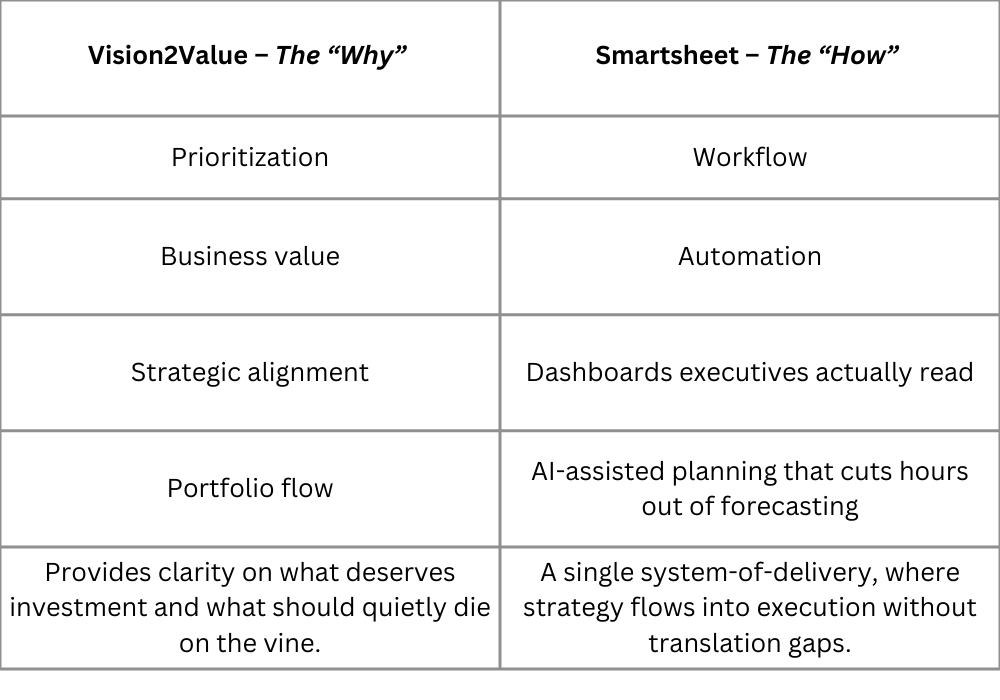
This is where Vision2Value and tools like Smartsheet finally meet.
Here's the truth I share with every PMO leader who’s drowning in tools:
It’s about choosing the one that aligns with the way your organization thinks about value.
Smartsheet happens to map extremely well to Vision2Value because both are built around flow, adaptability, and visibility. But the bigger point is: 2026 PMOs weave frameworks and technology together.
Data, AI, and Automation: The Forces Reshaping Portfolio Delivery
Executives are asking for predictions while giving you moving targets. They want precision at the same time they’re demanding speed. It’s an impossible expectation to meet with human effort alone and that’s exactly why data, AI, and automation are becoming central to portfolio delivery. Not as replacements for PMOs, but as extensions of what a modern PMO is capable of influencing.
Here’s what’s reshaping us most:
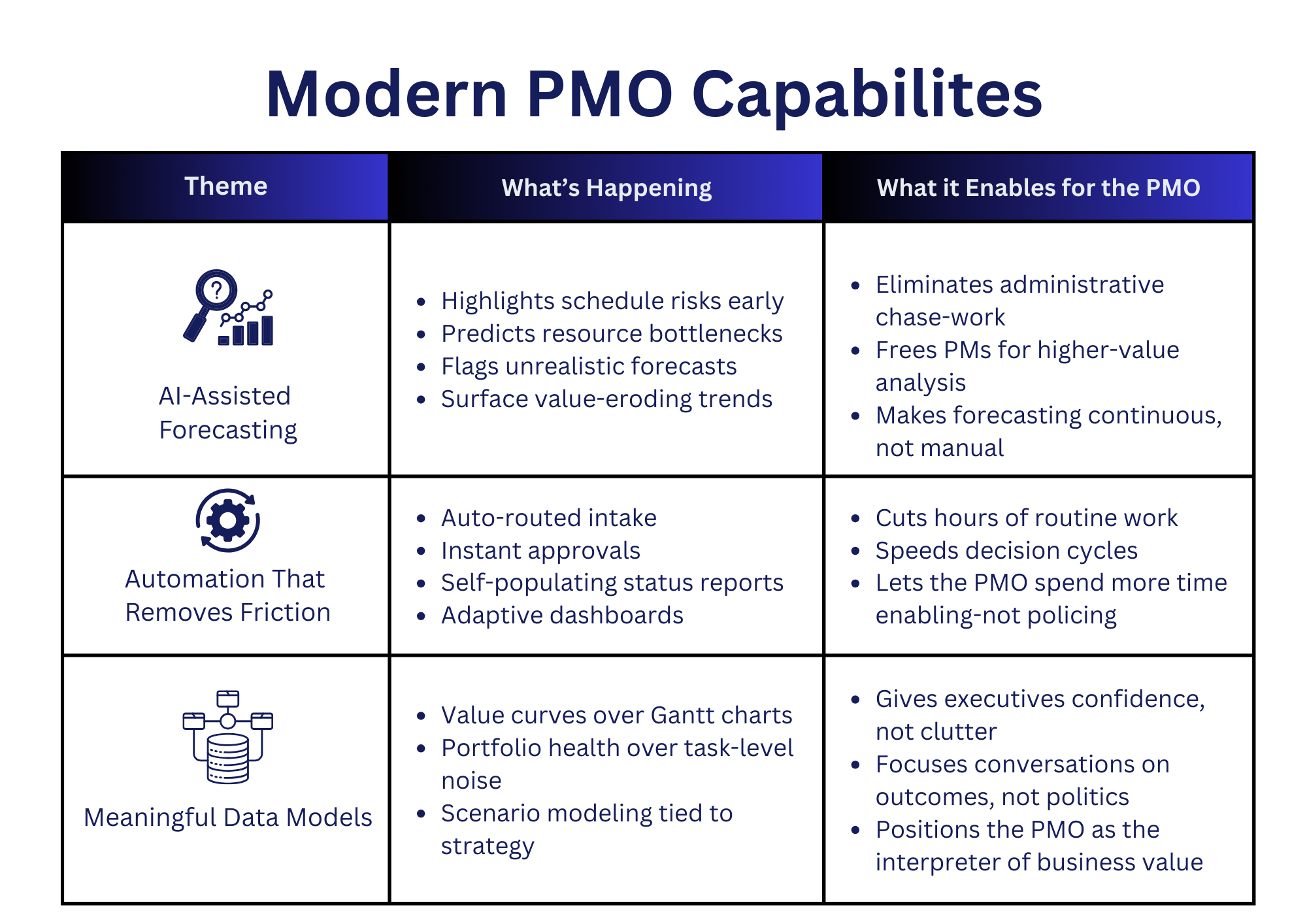
Data must still be accurate, but accuracy alone doesn’t drive decisions anymore. What matters is whether the PMO can interpret the signals inside that data, the shifts, the risks, and the value patterns leaders can’t see yet.
In 2026, leaders who know how to read those patterns will drive the most organizational impact.
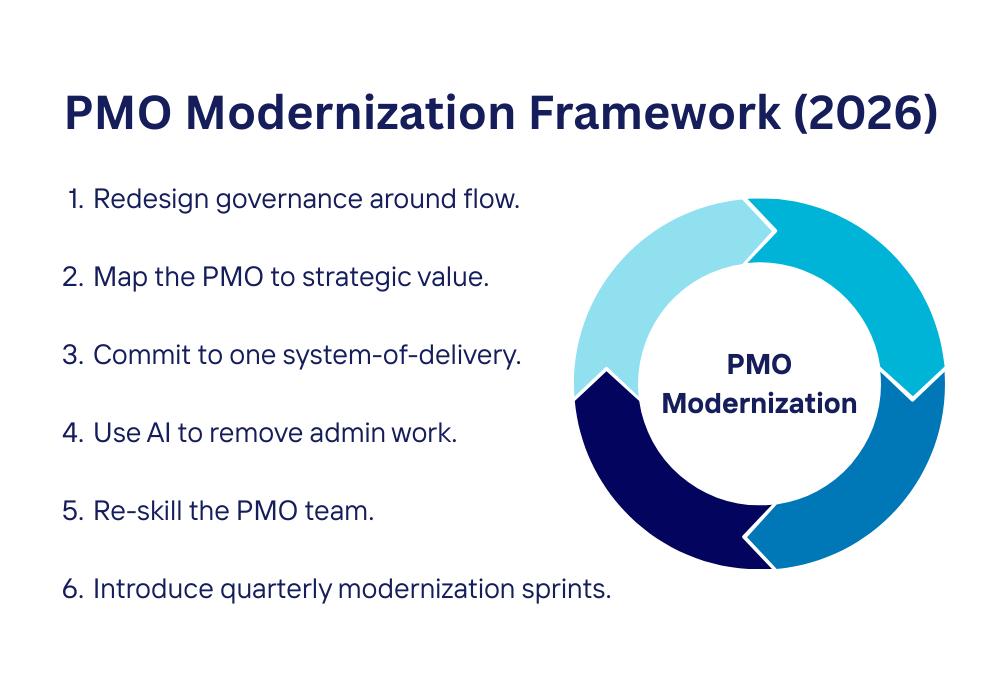
Action Steps to Future-Proof Your PMO (Starting This Quarter)
The path forward looks different in every organization, but the starting moves are universal.
These are the steps I advise every PMO leader to take right now:
The PMO of 2026 isn’t the future it’s already forming in the conversations inside your organization. You see it when the demand for decisions outpaces the pace of documentation.
We’re stepping into a new chapter where PMOs aren’t judged by how tightly they control the work, but by how effectively they accelerate it.
That’s the PMO I help leaders build. And if you're reading this, it’s probably the PMO you’re trying to build too.
And if you're ready to explore what modernization could look like in your organization, you can book a call with us or reach out here:
👉 https://www.pmoevolution.com/contact